The Intern Model Explained
The Draft I Killed at 6:40 A.M.
At 6:40 on a Tuesday morning, I was drinking coffee and reviewing messages my AI had drafted overnight. Forty-one of them, queued and waiting before the workday started. Number seventeen was a response to a customer asking if she could pause her subscription during a hospital stay.
The draft was warm, professional, and perfectly on-brand. It offered her a “hardship pause” with full benefits retained.
We didn’t have a hardship pause. The AI invented it because it sounded like something a caring company would offer.
I killed the draft, wrote the response myself, and logged the error. Total time: about ninety seconds. That log entry later became a constraint in the system’s instructions—more on that in Principle 4.
That system—the one I described in the last chapter—processes 72,000 customer messages a month across SMS, email, Facebook Messenger, and Instagram DMs. In one 90-day period, the workflows I designed booked $700,000 in new contracts for a client. And the technology wasn’t special. I used the same tools available to everyone—ChatGPT, Claude, standard automation platforms. The companies whose pilots failed had access to identical technology, often with larger budgets.
The difference was the operating model.
Every AI touchpoint in my system follows the same pattern: clear task definition, mandatory human review at critical points, trust levels that match demonstrated reliability, and feedback loops that catch problems before they compound. I treated every AI component the way a good manager treats an intern—capable and eager, but requiring supervision until it proves itself on simpler tasks first.
AI is your intern, not your CEO. It drafts. You decide.
That’s the intern model.
Why “Intern” Is the Right Mental Model
Other mental models for AI create the wrong expectations:
“Tool” implies reliability and predictability. A hammer works the same way every time. AI doesn’t. The same prompt can produce different outputs, and those outputs can be confidently wrong.
“Assistant” implies it understands context and intent. Your human assistant knows when you’re stressed, remembers your preferences, and can read between the lines. AI can’t. It processes exactly what you give it.
“Oracle” implies authority and accuracy. People treat AI outputs as research findings rather than first drafts. This is how a ChatGPT-invented case ended up in a motion to overturn a $24 million verdict—and how, when it was flagged, the firm’s first instinct was to defend the filing rather than audit it. Two dozen documented misrepresentations later, the sanctions arrived.
“Automation” implies set-and-forget capability. Traditional automation is deterministic—the same input produces the same output. AI is probabilistic. It requires ongoing supervision.
“Intern” works because it sets the right expectations:
| What’s True of Interns | What’s True of AI |
|---|---|
| Eager and fast | Generates output quickly |
| Confident even when wrong | No uncertainty signaling |
| Needs clear instructions | Performs best with specific prompts |
| Requires review | Outputs need verification |
| Improves with feedback | Can be refined with iteration |
| Not appropriate for all tasks | Has clear limitations |
When you think “intern,” you naturally build in the supervision structures that prevent AI failures. You wouldn’t let an intern send an email to your biggest client without reviewing it first. You shouldn’t let AI do it either.
But I want to be honest about where the metaphor breaks, because the break is the most important part.
A real intern learns. Correct her once and she remembers next month. Your AI intern shows up every morning with amnesia. It doesn’t remember yesterday’s correction, last week’s embarrassment, or the constraint you explained twice. Nothing you say in one session carries to the next unless you build the carrying mechanism yourself.
That’s why the intern model is a system, not a management style. With a human intern, the person holds the memory. With AI, the system has to hold it—in task definitions, in constraints, in review checklists, in logged error patterns. The four principles that follow aren’t tips for supervising AI. They’re the external memory your amnesiac intern can’t supply.
Principle 1: Clear Tasks
Never say “handle this.”
Vague tasks create vague outputs. When you tell AI to “write a report on Q3 sales,” you’ll get a generic report that requires heavy rewriting. When you tell AI exactly what you need—specific sections, specific metrics, specific format—you’ll get output you can actually use.
I use a framework called SCOPE for task definition:
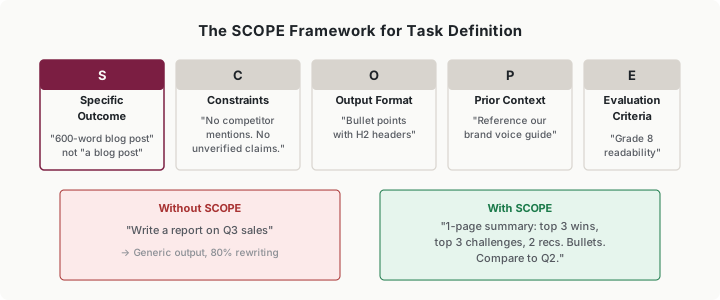
- Specific outcome: What exactly do you need? “600-word blog post” not “a blog post.”
- Constraints: What must it NOT do? “No competitor mentions. No unverified claims.”
- Output format: How should results be structured? “Bullet points with H2 headers.”
- Prior context: What background does it need? “Reference our brand voice guide.”
- Evaluation criteria: How will you judge success? “Readable at Grade 8 level.”
Here’s the difference in practice:
| Vague Task | SCOPE Task |
|---|---|
| “Write a report on Q3 sales” | “Create a 1-page summary of Q3 sales highlighting top 3 wins, top 3 challenges, and 2 recommendations. Use bullet points. Compare to Q2. No revenue figures without source citation.” |
| “Handle customer emails” | “Draft responses to refund requests using our standard template. Flag anything over $500 for human review. Match the tone in examples 1-3.” |
| “Analyze this data” | “Find the top 5 products by revenue growth rate. Output as a table with product name, Q2 revenue, Q3 revenue, and growth %. Note any data quality issues.” |
The time you invest in clear task definition pays back immediately. When I rebuilt my refund-request brief with explicit constraints and tone examples, editing time per draft dropped from roughly 20 minutes to under 5.
The constraint section—the C in SCOPE—deserves special attention. This is where you prevent the most common AI failures. Common constraints I include:
- “Do not make claims that cannot be verified from the provided sources”
- “Do not mention competitors by name”
- “Do not use superlatives (best, fastest, leading) without data”
- “Flag any request for information not in the provided context”
Think of constraints as the guardrails that prevent your intern from wandering into dangerous territory. You wouldn’t expect an intern to know your company’s competitive sensitivities or legal boundaries without being told. AI doesn’t either.
The invented hardship pause at the top of this chapter was this failure exactly. The draft’s goal—sound like a caring company—was clear, and the AI pursued it straight past a rule nobody had written down: only offer policies that exist. Stated goals beat unstated constraints—by default, every time. An AI chasing the goal you wrote will cheerfully violate the rule you didn’t. That’s why the sharpest constraints name what the output must never do, not just what it should—the standing Never List you’ll build into every input template in the input-design chapter, blunt enough that the goal can’t run around it.
Principle 2: Review Before Shipping
Clear tasks make the second principle affordable: review everything before it ships.
Nothing AI produces goes to customers, stakeholders, or external parties without human review. Period.
Not all review needs the same rigor, though. Matching scrutiny to stakes is what makes AI sustainable at scale. I call the four levels the Review Spectrum:
| Stakes Level | Review Level | Time Investment |
|---|---|---|
| Low (internal notes) | Scan | 30 seconds |
| Medium (team docs) | Spot-check | 2-5 minutes |
| High (customer-facing) | Deep review | 10-30 minutes |
| Critical (legal, financial) | Rewrite | 1+ hours |
For low-stakes content—internal meeting summaries, personal research notes—a 30-second scan is enough. Read the first and last paragraphs, check any numbers or names, verify the tone is appropriate, and move on.
For customer-facing content, you need a deep review. Check facts against sources. Verify the tone matches your brand. Make sure nothing could be misinterpreted.
For critical content, treat the AI draft as raw material only. A human rewrites it completely, and a second reviewer checks the result before it ships.
Remember the 95% of organizations getting zero return on their AI investments? Many of them die right here, at the review step. Organizations either review everything exhaustively (unsustainable) or review nothing (dangerous). The fix isn’t more review or less review—it’s matching scrutiny to stakes.
When review catches problems, don’t just fix them—document the pattern. A recurring error becomes a constraint in your SCOPE definition or a trigger for closer review on similar tasks.
Principle 3: Incremental Trust
Review generates the evidence that powers the third principle: trust that’s earned, not assumed.
Start small. Expand AI’s role only after demonstrated reliability in your specific context. I visualize this as a Trust Ladder with four rungs:
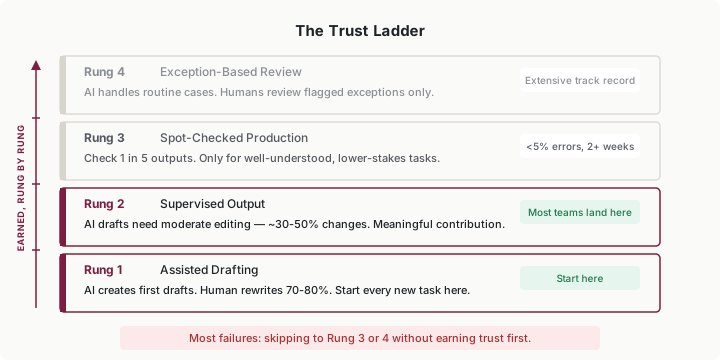
Rung 1: Assisted drafting. AI creates first drafts. Human rewrites substantially—often 70-80% of the content changes. This is where everyone should start with any new AI task.
Rung 2: Supervised output. AI creates drafts that need moderate editing—maybe 30-50% changes. The human is still actively shaping the output, but the AI’s contribution is meaningful.
Rung 3: Spot-checked production. AI creates output that goes live with sample-based review. You might check 1 in 5 outputs rather than all of them. Only appropriate for well-understood, lower-stakes tasks.
Rung 4: Exception-based review. AI handles routine cases autonomously. Humans only review flagged exceptions. This level requires extensive track record and robust error detection.
Most organizations try to start at Rung 3 or 4. That’s why they fail.
The progression criteria for moving up a rung:
- Error rate below 5% for at least two weeks
- Edge cases well-documented
- Rollback process is clear
- Team is comfortable with current level
Warning signs that you should step back:
- Errors that should have been caught
- “That’s weird, it usually works”
- Overconfidence from the team
- New use cases that weren’t tested
Trust isn’t global—it’s task-specific. AI might earn Rung 3 trust for social media posts while staying at Rung 1 for customer contracts. Different tasks, different risk profiles, different trust levels.
Principle 4: Feedback Loops
Every AI interaction is data. The fourth principle is what turns the first three from a checklist into a system that improves itself: capture that data and act on it.
Remember the hardship pause from the opening of this chapter? Here’s what happened after I killed the draft. The error went into a log—one line in a spreadsheet: invented a policy we don’t have. Two weeks later, the log showed three more entries in the same family: a made-up loyalty discount, a return window that didn’t exist, a “free consultation” we’d never offered. Four fabricated policies in two weeks isn’t four accidents. It’s a pattern.
So the pattern became a constraint: “Only reference policies listed in the provided policy document. If a customer asks about anything not covered there, flag for human review.” Fabricated-policy errors went from roughly one a week to zero the following month. That’s the loop: the error taught the system, and the system stopped making the error.
The feedback loop has four components:
- Capture: Log errors, near-misses, and successes. A simple spreadsheet works.
- Categorize: What type of failure? Factual error, tone problem, format issue, scope creep?
- Correct: Update prompts, task definitions, or review processes based on patterns.
- Confirm: Verify the fix actually works on similar cases.
This doesn’t need to be complicated. A 5-minute weekly retro that answers three questions is enough:
- What AI outputs worked well this week?
- What required significant correction?
- What pattern can we address?
The weekly retro is what separates teams that plateau with AI from teams that continuously improve.
Putting It All Together
The four principles work as a system. Here’s how they connect:
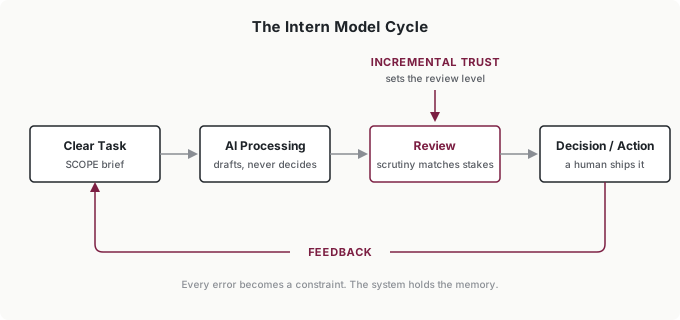
Clear tasks produce better AI output, which makes review easier. Review catches errors that feed back into better task definitions. As error rates drop, trust increases, which adjusts review levels. The system improves itself over time.
The first week you implement this will feel like overhead. It felt that way when I built my first workflow too—right up until the review queue caught its first expensive mistake. The overhead is the system working.
Putting It Into Practice
Elena manages a twelve-person marketing team
Elena’s B2B software company tripled its content requests, but her headcount stayed flat. Her team was drowning.
She started with the tasks. Every AI request now begins with a brief—word count, target persona, constraints, format, success criteria. AI output went from requiring 80% rewriting to 30% editing. Review got tiered to match the stakes: internal notes get a 30-second scan, blog posts get full editing, case studies get editing plus subject matter expert review.
Trust was earned one content type at a time. Everyone started at Rung 1 for everything; social posts reached Rung 3 after six weeks, while blog posts were still at Rung 2 at month three—and that was fine. The feedback loop surfaced the pattern that mattered most: AI couldn’t fake customer voice in case studies. The fix was a new constraint—real customer quotes must be provided in the brief, and the AI writes around them.
Result: content output tripled from 24 to 72 pieces per month. Quality scores from sales improved from 3.2 to 3.8 out of 5, because the team had more time for strategic work instead of grinding through first drafts.
Jordan is a financial analyst at a private equity firm
Research consumed 60% of Jordan’s time—synthesizing earnings calls, 10-Ks, industry reports.
Jordan developed a research summary template specifying exactly what to extract: three key metrics with numbers, two management outlook quotes, one risk factor, one competitive statement, confidence rating 1 through 5. Internal notes got 60-second spot-checks; anything in client materials got full verification against sources. Earnings calls reached Rung 3 after two months. Foreign filings stayed at Rung 1 permanently—too much variability.
The feedback loop caught the important patterns: AI missed non-GAAP reconciliations (added to template) and misattributed quotes in multi-speaker transcripts (required speaker names).
Result: research time dropped from 40 hours to 16 hours per deal. Documents processed per week jumped from 25 to 70. Six months later, Jordan was promoted—the extra research capacity didn’t hurt.
Nadia runs a twenty-five-person e-commerce company
As CEO, Nadia wore too many hats. She spent the first two hours of every morning scanning Slack, email, and dashboards before she could make a single decision. By the time she had context, the morning was gone.
She applied the intern model to her daily briefing. Clear task: summarize overnight Slack activity, flag support tickets over two hours old, pull yesterday’s top five products by revenue and any that dropped more than 20%, format as bullets with one-sentence context. Constraints: no commentary or recommendations—just the facts. Trust level: Rung 2—she read every briefing in full and verified any number that would drive an action before acting on it.
Within a month, Nadia’s morning context time dropped from two hours to ten minutes. She started her first real meeting at 8:30 instead of 10:00. More importantly, the briefing surfaced a slow inventory buildup she’d have missed for weeks scanning dashboards casually.
Miguel is VP of Operations overseeing three distribution centers
Miguel needed to synthesize weekly reports from three facility managers, each with different formats and levels of detail. By the time he’d read and compared all three, he had no time left for the cross-site analysis that was actually his job.
He built a SCOPE brief: extract safety incidents, throughput variance versus target, top equipment issue, and staffing gaps from each facility report, then present as a side-by-side comparison table. He ran it at Rung 2 for a month, spot-checking numbers against the original reports, and his feedback log revealed that AI consistently missed context buried in paragraph text. New constraint: “Extract from narrative sections, not just tables.”
Then he did the thing that made it a senior-leader move rather than a productivity hack: he turned his own pilot into the standard. His three facility managers now use the same brief and the same review levels for their own reporting workflows, with Miguel’s error log as the shared starting point. Report synthesis dropped from half a day to 45 minutes, and the cross-site benchmarking he finally had time for identified $140,000 in shared equipment savings his first quarter.
Common Objections
“This is too rigid. AI should be more flexible.”
The structure isn’t about limiting AI—it’s about making its output reliable. My messaging system handles 72,000 messages a month precisely because every workflow is rigid about tasks, review, and trust. Flexibility without reliability is chaos at scale.
“My use case is different.”
The principles scale and adapt. Elena runs a 12-person team. Jordan works solo. Nadia runs a company. All of them need clear tasks, review, incremental trust, and feedback loops. The implementation details change; the principles don’t.
“This sounds like a lot of overhead.”
It’s less overhead than fixing mistakes after they’ve reached customers. One fabricated policy that ships to a customer costs more goodwill—and more cleanup time—than a month of 90-second review passes. Elena’s 3x content output didn’t come from working harder; it came from eliminating wasted effort on vague tasks and heavy rewrites.
“Won’t AI get better and make this unnecessary?”
Maybe someday. But right now, even the most advanced AI models confidently produce errors. The intern model isn’t about AI’s limitations being permanent—it’s about operating effectively with AI as it exists today. When AI improves, you adjust your trust levels. The framework accommodates that. But waiting for AI to become trustworthy before using it means missing years of productivity gains.
“I tried something like this and it didn’t work.”
The most common failure mode I see: people jump straight to Rung 3 or 4 without the track record those rungs require. The output looks good, so they stop reviewing closely—but sample-based review only works when you have a baseline to catch drift against. No baseline, no feedback loop. No feedback loop, no improvement. If you tried this before and it didn’t work, check whether you actually climbed the ladder or just skipped to the top.
Your Monday Morning Action Item
Pick one task you currently use AI for—or want to start using AI for.
Write out the SCOPE definition:
- Specific outcome:
- Constraints:
- Output format:
- Prior context:
- Evaluation criteria:
Run the task with your new definition. Compare the output to your previous approach.
That’s it. One task. One clear definition. Start at Rung 1 with full review. Log what happens.
The rest of the intern model will follow naturally—the first error you catch in review will teach you more than this chapter did.
The intern model isn’t complicated. It’s just disciplined. And discipline is what separates the organizations that get real value from AI from the majority that don’t.