Developing Your AI Collaboration Skills
The Folder Isn’t the Two Years
Someone could copy my entire ai-system folder tomorrow and not get my results.
That’s not false modesty about the folder—every file in it earns its place. But the folder is the artifacts. The two years are in the operator: the instinct for what context a task needs before the output proves it was missing, the fast read on whether a draft is fixable or doomed, the reflex that says this one I don’t hand to the AI at all. The last chapter was about what you built. This one is about who you became building it—and how to keep becoming it on purpose.
I can date my own version of this. Early on, my results were coin-flip: some sessions produced drafts I barely touched, others produced expensive garbage, and I couldn’t have told you what I did differently between them. The tools I use today aren’t dramatically better than what I had then. My results are. The variable that moved was me—and the movement wasn’t accidental. Somewhere in that first year I started treating each session as a rep instead of an errand, and the coin-flip variance collapsed.
Here’s the reframe that makes the whole topic tractable: you’re not learning to use AI. You’re learning to manage. Every skill that separates people who get consistently excellent AI results from people who get coin-flip results is a management skill—briefing, reviewing, delegating, recognizing situations you’ve handled before, and knowing what not to hand off. None of them were invented for AI. All of them work on the intern.
And that’s why the anxious question—“won’t these skills be obsolete when the tools change?”—has such a settled answer. Nobody asks whether management skills will survive the next org-chart software. Briefing, reviewing, and delegating transferred from typewriters to email to Slack without losing a step. They’ll transfer to whatever replaces your current AI, too.
The Five Skills of Managing an Intern
You’ve been practicing all five of these for the whole book. This chapter names them, so you can get deliberately better at each one.
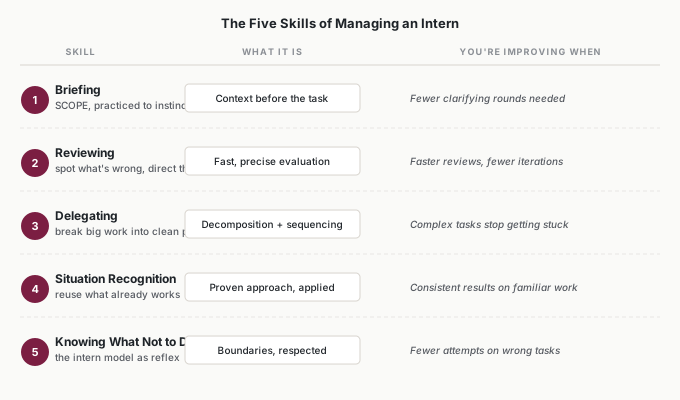
Briefing. Giving the intern what it needs before the output proves something was missing. This is SCOPE practiced until it’s instinct—knowing which context matters for which task type, structuring it so the important parts lead, and noticing the gap before the bad draft reveals it. When I started, I discovered my briefing failures one mediocre output at a time. Now the missing constraint itches before I hit enter—a skill I can’t fully explain, but I can tell you exactly how it formed: hundreds of briefs, each one graded by the output it produced. You’re improving when first drafts hit the mark more often and the clarifying questions stop coming.
Reviewing. Evaluating output fast and directing the fix precisely. You know the Review Spectrum; this is getting quick at choosing the rung and giving direction that actually works. “This isn’t quite right, try again” is a coin flip. “The tone is too formal for this audience—more conversational, same key points” is a fix. The advanced version is the iterate-or-restart call: some flawed drafts can be refined, and some are polished versions of the wrong approach. Learning to tell them apart saved me more time than any prompt trick I know. A good rejection has an anatomy, and most people stop at the first part. Recognition is seeing the draft is wrong—what your domain expertise buys you. Articulation is saying why as a reusable rule: not “this is off” but “you led with the discount; lead with the apology.” Encoding makes it persist—the master prompt from two chapters back is where a good “no” goes to stay. Skip the last two and your rejections stay shrugs; done in full, they end up worth more than your prompts. You’re improving when review cycles shrink and your feedback produces the improvement you asked for.
Delegating. Breaking complex work into pieces an intern can actually handle—the skill underneath everything you did in the building chapters. “Prepare the quarterly presentation” is five delegations wearing one sentence: research, analysis, structure, drafting, design. Skilled delegators see the seams before starting, sequence the handoffs cleanly, and also know when not to decompose—some complex-seeming requests work fine whole. You’re improving when complex tasks stop getting stuck in the middle.
Situation recognition. Knowing when you’ve handled this before, and reaching for the proven approach instead of reinventing one. (This is the constructive twin of the error-pattern eye you built in the review chapters—that one recognizes what goes wrong repeatedly; this one recognizes what works repeatedly.) A customer complaint email and an employee feedback message look different, but if both are “deliver difficult news constructively,” the same pattern applies—and your task library is where that pattern lives. The discipline is also noticing when a situation only looks familiar: my most expensive situation-recognition mistake was treating a new channel like an old one because the tasks rhymed, and the tone norms didn’t. You’re improving when familiar work produces consistent results and your task library keeps growing.
Knowing what not to delegate. The intern model’s founding premise, practiced until it’s reflex. AI excels at synthesis, pattern matching, and generating alternatives; it’s unreliable for current facts, deep specialist judgment, and truly novel situations. The warning signs are ones you already know—confident-but-vague responses, repetitive suggestions that don’t progress, plausible outputs that feel off. And sometimes the answer is simply that direct human effort wins: a three-sentence email to someone you know well takes less time to write than to brief. You’re improving when you stop having failed attempts on tasks that were never AI-shaped to begin with.
Five skills, one job description: manager—and increasingly, a manager of an intern you don’t watch work. More of the job now happens off your desk: the intern runs a multi-step task while you’re in a meeting, works a queue overnight, comes back with an assignment finished. When the work moves out of sight, the same five skills express as concrete habits. You checkpoint before you let it act—a known-good state saved before an unsupervised run, so a bad session costs you a rollback, not a mess. You start clean when the thread turns, because a fresh session beats one polluted by three failed attempts. The constraints you’d otherwise retype every time go into a standing rules file the intern reads first. You hand off in small batches you can actually check, not one heroic request you can only rubber-stamp. And because an unwatched intern can’t raise its hand, the anticipating you once did in the moment moves up front, into the brief. Same five skills. Higher stakes—the supervision just moved from during the work to before it.
The Layer That Persists
What changes and what doesn’t isn’t hair-splitting—the distinction decides where your learning time should go.
What changes: interfaces, features, model names, pricing, capabilities. The AI tools of two years ago look different from today’s, and today’s will look different in two more. Anyone who invested in memorizing a specific tool’s behaviors—which buttons, which magic phrases, which quirks—has watched that knowledge depreciate on every update.
What doesn’t change: the interaction itself. You will still need to brief whatever you’re delegating to. You will still need to review what comes back. You will still need to break big work into pieces and know which pieces to keep. These requirements come from the nature of delegation, not from any tool—which is why they were true of human interns before AI existed and will be true of whatever comes next.
This is why feature-chasers feel like they’re perpetually starting over while skill-builders feel like they’re continuously accumulating. The feature-chaser’s knowledge lives in the tool, and the tool keeps moving. The skill-builder’s knowledge lives in themselves.
There’s a deeper reason this layer is worth your time: it’s the one part of your work that can’t be bought. Compute is for sale. The models are the same ones everyone else is renting. What isn’t for sale is judgment—the accumulated sense of what good looks like in your specific work—because judgment can’t be uploaded. It has to be built, one decision at a time, which is exactly why it compounds. Every rep is a deposit no one can make for you, and a year of them is an advantage no one can shortcut. Money doesn’t compress this part.
The self-interested version of this changes who the work is for. The further you rise, the more your expertise compiles—from explicit steps you could dictate into automatic judgment you can no longer catch yourself making. It’s why the people with the most to delegate are often the worst at briefing: their own operating system has gone invisible to them. Delegating forces you to decompile it back into words—the Decompile Drill from the input-design chapter, narrating your judgment aloud until it’s explicit again. And here’s what’s new. Articulating your tacit expertise used to be a chore you did for the org: the wiki nobody updated, the handoff doc you wrote on your way out. Now the judgment you write down runs your own intern, today, on your own work. For once, documenting what you know pays the person documenting it. Knowledge management finally has a personal incentive—and it arrived disguised as a consumer AI tool.
Invest in the layer that persists.
Deliberate Practice, Not Habitual Use
Here’s the line that separates coin-flip results from consistent ones: habitual use produces experience. Deliberate practice produces expertise. (The term is Anders Ericsson’s, from the research on how experts actually form—and the finding transfers: hours alone don’t build skill; intentional, feedback-rich hours do.)
The improvement loop takes seconds, not sessions. Before an interaction, notice your approach: what task, what context, what expected output. During, execute intentionally—notice when you deviate and what drives the iterations. After, spend thirty seconds encoding: what worked, what you’d change, what belongs in the folder. That last step is the deposit habit you already have—the loop just points it at your skills as well as your artifacts.
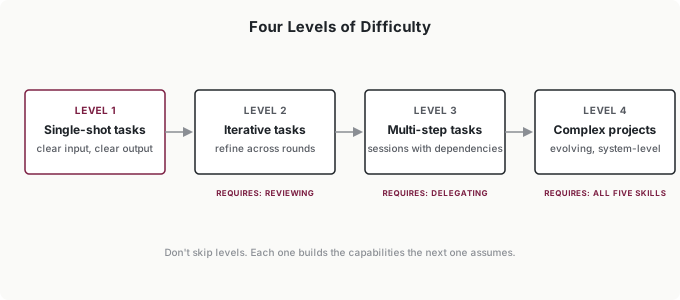
Practice needs appropriate challenge, and AI work has a natural difficulty ladder. Level 1: single-shot tasks—clear input, clear output (“summarize this article”). Level 2: iterative tasks—context builds across rounds; success requires reviewing skill. Level 3: multi-step tasks—several sessions with dependencies; success requires delegating skill. Level 4: complex projects—many interactions, evolving requirements, all five skills working together. Don’t skip levels. Each one builds the capabilities the next one assumes—my own dashboard failure was a level 4 attempt on level 1 skills, and it went exactly how skipping three levels goes.
The Practice Rhythm
This rides the calendar you already keep—it doesn’t add a second one.
Daily, the only new ask: one deliberate interaction. Not every interaction—one, where you pick a skill and pay attention. Before, during, after. It’s an interaction you were going to have anyway; the difference is consciousness.
Weekly: the ten minutes you already spend on the folder gains one question—which skill was weakest this week? The answer sets next week’s focus. Maybe your briefing is sharp but your iterate-or-restart calls keep going long. Next week, that’s the daily rep.
Quarterly: the honest hour you already run on the system gets a skills half: rate yourself on the five, honestly. Where are you improving? Where have you plateaued? Then one question that isn’t about the five skills at all: has your task list changed? If what you hand the AI today is the same list you handed it six months ago, you’re not improving—you’re automating the familiar, which feels like progress and isn’t. The countermeasure is deliberate: book yourself scouting hours—time spent not executing known tasks but hunting for ones you’ve never tried handing off. Growth shows up as a task list that keeps gaining rows, not just a shorter clock on the rows you already had.
Feedback is what turns reps into skill, and three signals are enough: time to acceptable output (falling?), iterations needed (fewer?), and how your outputs perform in actual use—did the memo land, did the analysis hold. If those trend right over months, the practice is working. If they’re flat, change what you’re practicing—flat lines usually mean the reps got too comfortable, not that the method failed.
The compounding here is real but quiet. There was no week where my delegating became automatic—there was just a month I noticed it had been automatic for a while. That’s how skill compounding works: consistency beats intensity, and the person who practices ten minutes daily outruns the person who does a workshop per quarter, because the daily person has three hundred feedback loops a year and the workshop person has four.
Three habits reliably derail the practice. Random use without intention—hours of habitual AI interaction that never converts to skill because nothing gets noticed or encoded. Comfort-zone persistence—mistaking a reliable routine for a growing skill; the task-list question above is the test that catches it. And comparison paralysis—measuring your progress against the highlight reels online instead of against your own last quarter. Your month three should beat your month one. That’s the whole scoreboard.
Putting It Into Practice
Elena runs briefing reps
Elena’s team meeting gained a ten-minute segment: one writer brings the week’s worst AI output, and the team reverse-engineers the brief that would have prevented it. It’s deliberate practice disguised as a retro—her writers are drilling briefing skill on real failures, publicly, cheaply. The measurable result: her team’s revision rate has fallen every quarter since the segment started. The unmeasurable one: her newest writer briefs better at month three than her veterans did at year one, because he never learned the habitual way first.
Jordan practices the restart call
Jordan noticed his weakest skill through the weekly question: his review speed was fine, but he’d sink forty minutes into refining analyses that needed restarting. So that became the rep. For a month, every analysis got a forced two-minute checkpoint after the first draft: iterate or restart, decide now, note the reasoning. His dead-thesis file grew a new section—restart calls and how they aged. Most of his early “iterate” decisions, the record shows, should have been restarts; the sunk feeling of a half-refined draft kept overruling the evidence. The record is why the calls got better—you can’t argue with your own column of wrong decisions.
Tomás stays on the ladder
Tomás’s temptation is the founder’s version of skipping levels: delegating the practice itself. He has people who could run the AI work—but the skills compound in whoever does the reps, and a CEO whose judgment about AI comes secondhand is a CEO who can’t evaluate what his firm builds. So he keeps two level 2 tasks personally: the Monday anomaly review and the client-letter drafts. Not because delegation would fail, but because those reps are where his own briefing and reviewing stay sharp enough to manage everyone else’s.
Ingrid models it
Ingrid’s department has no mandatory AI training—deliberately. Mandated training produces attendance; what she wants is practice, and practice can’t be assigned, only normalized. So what her department has is visibility: her own weekly skill focus goes in her Friday notes, failures included (“this week: restart calls; verdict: still too slow to pull the plug”). Modeling deliberate practice from the senior chair does what mandates can’t—it makes skill development normal rather than remedial. Her one structural move ties to hiring: the AI-skills question in interviews is no longer “which tools have you used?” but “tell me about a prompt you got better at.” Tools tell her nothing. The improvement story tells her everything.
Common Objections
“I don’t have time for deliberate practice.”
You’re already having the interactions—the loop adds thirty seconds of attention to one of them per day. The weekly question rides a review you already run. This is the cheapest skill development you will ever do, because the practice material is your actual work.
“How do I know if I’m getting better?”
Three numbers: time to acceptable output, iterations per task, and real-world performance of what ships. Check them monthly, not daily—skill trends are visible in months. If they’re flat after a quarter, your practice is too comfortable; move up a level.
“I learn best by doing, not reflecting.”
Doing without reflection produces experience, not expertise. Ten years of habitual AI use is one year of learning repeated ten times. The reflection is thirty seconds—it’s not a journaling practice, it’s a glance in the rearview mirror.
Your Monday Morning Action Item
Start the daily rep this week.
Pick your weakest skill—if you’re not sure, it’s probably briefing; it usually is. Each day, choose one real AI interaction and run the loop: note your approach before, execute with attention, spend thirty seconds after on what worked and what didn’t. At week’s end, read the notes and pick next week’s focus.
That’s the entire practice. One interaction a day. The simplicity is the point—it’s the version you’ll still be doing in a year, and the version you’ll still be doing is the only version that compounds. I’ve watched people design elaborate skill-development programs for themselves and abandon them by week two; the thirty-second loop survives because it costs almost nothing on the days you’re busy, which is most days.
And a year matters here more than it seems, because these five skills are about to become the most portable asset you own. The tools on your screen will be different next year. The folder can be rebuilt. But briefing, reviewing, delegating, recognizing situations, and knowing what not to hand off—those travel with you, across tools, across jobs, across whatever the next wave looks like.
Your tools will change. Your skills will transfer. Start building them now.