Career Protection
The Accountability Question
Early in my social media workflow, I used AI to draft a competitive analysis that compared our response times to industry benchmarks. The numbers looked reasonable. The analysis was well-structured. I sent it to leadership as part of a quarterly review.
A week later, my director pulled me aside. Two of the benchmarks were fabricated—the AI had generated plausible-sounding statistics that didn’t match any published source. Nobody questioned the AI. They questioned me: “Why didn’t you verify these numbers before presenting them to the executive team?”
I got lucky. The stakes were internal, and the damage was a bruised reputation rather than a legal problem. The nightmare version of this—the one that keeps compliance officers up at night—goes further: an AI-generated product comparison ships in a major campaign, a competitive claim turns out to be wrong, and a competitor’s legal team notices. Then it’s not a bruised reputation. It’s a pulled campaign, public corrections, and lawyers.
At every point on that spectrum, the question is never “what did the AI do wrong?” It’s always “why didn’t you catch this?”
AI doesn’t take responsibility. You do. Every AI output that carries your name carries your accountability. When things go well, the organization celebrates efficiency. When things go wrong, they examine your judgment.
The Accountability Asymmetry
Organizations handle AI outcomes with a structural imbalance you need to understand.
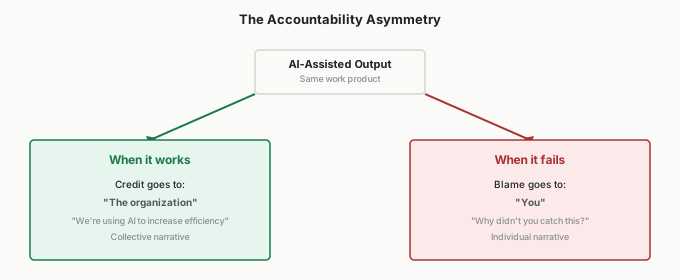
Credit and Blame Distribution
When AI-assisted work succeeds, the narrative is organizational: “We’re using AI to increase efficiency.” When AI-assisted work fails, the narrative becomes individual: “Why didn’t you catch this?”
This isn’t fair—but it’s predictable. Organizations adopt AI because it promises productivity gains. Those gains only materialize if AI outputs are usable. Usability requires human judgment. When unusable outputs slip through, the human judgment is what failed.
Recognizing this asymmetry is just seeing the field clearly. You can’t change the structure, but you can navigate it.
Why the Asymmetry Exists
The accountability asymmetry exists for structural reasons, not malicious ones. Organizations need humans in the accountability chain because AI can’t be held responsible in any meaningful way. You can’t fire an AI. You can’t sue an AI. You can’t put an AI on a performance improvement plan.
More practically, AI outputs are probabilistic. The same prompt can produce different results. The same model updates over time. The same question might get a correct answer today and an incorrect one tomorrow. This variability means AI outputs require human judgment about whether they’re acceptable for a given purpose—and that judgment creates accountability.
Understanding this helps you respond appropriately. The goal isn’t to fight the asymmetry or complain about its unfairness. The goal is to operate within it skillfully, protecting yourself while still capturing AI’s benefits.
Three Accountability Traps
The Automation Trap. “The AI did it” is not a defense. You chose to use AI. You chose to accept its output. You chose to submit work with your name on it. Your judgment—not the AI’s capabilities—is what’s questioned when problems emerge.
The Efficiency Trap. AI saves time. That’s the point. But when you use time savings elsewhere and a problem emerges later, hindsight questions whether you “should have checked more carefully.” The time savings that seemed like a benefit become evidence of insufficient review.
The Precedent Trap. Early AI successes create expectations. “It worked before” becomes an assumed baseline. When novel failures occur—and they will, because AI limitations are probabilistic, not absolute—they get judged against an inflated expectation of reliability.
These traps aren’t reasons to avoid AI. They’re reasons to use it with appropriate protection.
Documentation as Protection
After my benchmark embarrassment, I started documenting every significant AI-assisted decision. It takes minutes and provides substantial protection—and it’s the single most important career protection practice for AI users.
Why Documentation Matters
Documentation protects you in three scenarios that matter most:
When questioned about a decision. If someone asks why you made a particular choice, documentation shows your reasoning was deliberate. “I used AI for initial draft, reviewed for accuracy, verified key claims against source data” is very different from “I just used AI.”
When problems emerge later. If an AI-assisted output causes problems weeks or months later, documentation shows what you knew and did at the time. It demonstrates that problems weren’t foreseeable with reasonable diligence, or that you raised concerns that were overruled.
When handoffs occur. When work transfers to someone else—through reorganization, departure, or project transitions—documentation preserves context that otherwise lives only in your head.
What to Document
Decision records: What AI was used for. What human review occurred. Who approved the output. What the reasoning was for key choices.
Limitation acknowledgments: What the AI couldn’t verify or confirm. What assumptions were made. What follow-up was planned if assumptions proved wrong.
Escalation records: Concerns you raised. To whom. When. What responses you received. What decisions were made despite concerns.
Documentation Methods
Documentation doesn’t require elaborate systems:
Email trails create timestamps automatically. A quick email to yourself or stakeholders documenting a decision takes 30 seconds and creates a searchable record.
Brief notes in project files preserve context where the work lives. A comment block or metadata note captures key decisions alongside the work itself.
Checklist annotations formalize what review occurred. A checklist with initials and dates shows systematic attention rather than ad hoc acceptance.
Meeting minutes inclusion captures decisions in collaborative settings. “Reviewed AI-generated analysis; Sarah flagged concern about market sizing assumptions; team agreed to proceed with caveat” documents the decision process.
The Two-Minute Standard
If documentation takes more than two minutes per significant AI-assisted decision, you’re overdoing it. The goal is creating a record, not writing a treatise. My own log entries rarely run past two lines—task, what the AI did, what I checked. Brief notes that capture the essentials provide most of the protection.
Building Professional Credibility
Beyond documentation, how you use AI affects your professional reputation. Where you fall on the credibility spectrum shapes how colleagues and leadership perceive your judgment.
The Credibility Spectrum
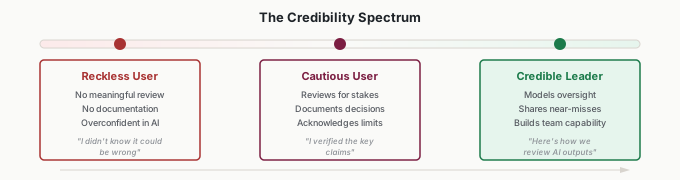
The Reckless User accepts AI outputs without meaningful review. No documentation exists. Overconfidence in AI accuracy leads to surprise when problems emerge. “I didn’t know it could be wrong” is their defense—and it’s weak.
The Cautious User reviews AI outputs appropriately for the stakes involved. Documents key decisions. Acknowledges AI limitations openly. Prepares for potential problems rather than being surprised by them.
The Credible Leader models appropriate oversight for others. Shares learnings from near-misses—situations where review caught problems before they mattered. Builds team capabilities around thoughtful AI use. Advances AI adoption deliberately rather than recklessly.
Most professionals start as Cautious Users and aspire to become Credible Leaders. The key differentiator is transparency about process. Credible Leaders don’t hide how they work—they demonstrate it, creating templates that others can follow.
Moving Up the Spectrum
Catch errors before they matter. When your review catches an AI mistake, that’s valuable. It demonstrates the importance of human oversight. It justifies the time invested in review. It shows your value beyond simple AI acceptance.
Document the save. When you catch a problem, make a brief record. Not for credit-seeking, but for evidence that review processes work. In my own log, the saves are the entries I end up citing most. These records become valuable when justifying review time or when advocating for appropriate oversight.
Share learnings appropriately. When you learn something about AI limitations or effective use patterns, share it with colleagues. Not as showing off, but as contributing to collective capability. Organizations value people who make others better.
Acknowledge limitations publicly. When presenting AI-assisted work, note what the AI did and what it couldn’t do. “AI generated the initial draft; I verified claims against our internal data and adjusted the framing for our audience.” This demonstrates sophistication, not weakness.
The Professional Liability Context
The American Bar Association has already issued formal guidance on generative AI, and other professional bodies are following. Lawyers who use AI for legal research still bear professional responsibility for the accuracy of their filings. CPAs who use AI for analysis still sign off on the accuracy of their work. Healthcare providers who use AI for decision support still own the clinical judgment.
This isn’t new—it’s existing professional liability frameworks applied to new tools. What’s new is that AI can produce confident-sounding outputs that are subtly wrong, and catching those errors requires domain expertise. The professional obligation to catch errors doesn’t diminish just because the tool that produced them sounded authoritative.
For non-licensed professionals, the pattern is similar even if formal professional liability doesn’t apply. Your employer expects you to exercise judgment. Your clients expect you to deliver accurate work. Your reputation depends on the quality of what you produce. AI assistance doesn’t change these expectations—it just adds a new category of potential errors to catch.
Managing Stakeholder Expectations
Your career protection extends beyond your own practices to how you manage others’ expectations about AI.
Managing Up
Be clear about capabilities and limitations. When leadership asks for AI assistance on projects, explain what AI can and cannot do reliably. Overpromising creates accountability exposure when AI falls short.
Set expectations about review time. AI doesn’t eliminate the need for review—it shifts what’s being reviewed. If leadership expects instant turnaround because “AI does the work,” reset that expectation early. I tell clients this in the first week of every engagement: the AI is fast, but my review is part of the deliverable.
Report near-misses appropriately. When review catches significant problems, report them. Not as complaints about AI, but as evidence that review processes are working and necessary. “This week, AI generated market sizing that would have been off by 3x—good thing we caught it” builds the case for appropriate oversight.
Escalate concerns early. If you’re being pressured to use AI in ways that concern you, raise those concerns before problems emerge. Early escalation creates a record and gives leadership the opportunity to adjust expectations.
Managing Sideways
Help colleagues understand limitations. Share what you’ve learned about AI capabilities with peers. Their failures affect team credibility, which affects yours.
Establish shared documentation practices. When teams adopt AI, advocate for documentation standards. Collective protection benefits everyone.
Don’t cover for poor AI use by others. If colleagues are using AI recklessly, don’t clean up silently. Either address it directly or ensure responsibility remains appropriately assigned.
Managing Down (for Leaders)
Model appropriate oversight. Your team watches what you do, not just what you say. If you accept AI outputs without review, they will too.
Create safe environments for error reporting. Teams that fear reporting AI problems hide them until they become catastrophic. Reward catching problems, not hiding them.
Build review into expectations. If you expect AI use, also expect review. Don’t create implicit pressure to skip oversight by celebrating only speed.
When to Say No
Sometimes the right answer is declining to use AI for a particular task, or declining to proceed without additional safeguards.
Red Flags
Stakes too high. Some decisions matter too much for AI assistance, given current reliability. Legal documents, medical decisions, financial disclosures—anything where errors create significant harm warrants extra caution.
Review time insufficient. If you don’t have time to review AI output properly, you don’t have time to use AI for that task. Speed without review isn’t efficiency—it’s risk transfer.
Documentation impossible. If you can’t document what AI contributed and what you verified, you’re accepting unknown accountability. That’s not a reasonable position.
Expertise gap too large. If you can’t evaluate whether AI output is correct, you shouldn’t be accepting it. AI confidence doesn’t indicate accuracy.
Pressure to skip oversight. “Just use AI and don’t worry about it” is a warning sign. Someone is trying to capture AI efficiency while transferring accountability to you.
How to Push Back
Frame as risk management. “I’m concerned about the liability exposure if this content contains errors we don’t catch” is more effective than “I don’t trust AI.”
Propose alternatives. “I can use AI for the draft, but I’ll need an additional day for verification” addresses the underlying need while maintaining protection.
Document your concerns. If you raise concerns, note that you did. Email is ideal—it creates timestamps and a clear record.
Escalate if overruled. If your concerns are dismissed and you’re told to proceed anyway, document the override. Then proceed as directed—but the decision record now includes that you flagged the risk.
Protecting the Record
When overruled on AI concerns:
Document your objection—what you were concerned about and why.
Document the override decision—who decided to proceed despite your concerns.
Document the date and context—when this happened and what information was available.
Then proceed as directed. You’ve done what you can do. The record protects you if problems emerge later. “I raised this concern on March 3rd; leadership decided to proceed” is a defensible position. “I never said anything” is not.
The Organization’s Response Tells You Something
How your organization responds to AI concerns tells you something important about its culture. Organizations that welcome thoughtful pushback are safer environments for AI adoption. Organizations that dismiss concerns or punish caution create environments where problems fester until they explode.
If you consistently find that raising concerns creates conflict rather than productive discussion, that’s valuable information. It might inform how you document (more carefully), how you escalate (more formally), or ultimately whether this organization’s AI practices align with your professional standards.
Applications
Tara (Customer Success Director, 12 Direct Reports)
Tara’s team started using AI to draft renewal proposals. Three months in, a rep submitted a proposal with AI-generated ROI projections that overstated client savings by 40%. The client caught it. Tara took the hit in the quarterly review.
Her fix: she created a team-wide documentation standard. Every AI-assisted proposal now includes a brief review note in the project file: what AI generated, what the rep verified, and which numbers came from actual client data versus AI estimates. She also added a “source check” column to the renewal template—each claim needs a data source tagged next to it. The documentation takes reps an extra three minutes per proposal and has caught two more fabricated statistics since implementation. Tara’s lesson for department leaders: build documentation into the team workflow, not just your personal practice. Your team’s AI mistakes become your accountability problem.
Jordan (Financial Analyst, Private Equity)
Jordan used AI to speed up quarterly earnings analysis—summarizing competitor filings, extracting key metrics, drafting comparison narratives. After his fabricated-benchmark scare (similar to mine), he developed a personal verification ritual: any number the AI produced got a 30-second source check before it left his desk. He kept a running log in a simple spreadsheet—date, task, AI contribution, what he verified, any errors caught.
In six months, Jordan caught 14 factual errors that would have made it into client-facing reports. More importantly, when his manager questioned a controversial analysis, Jordan pulled up the log and showed his verification trail. His manager’s response: “This is exactly the kind of rigor we need.” The log took him roughly 90 seconds per task. The credibility it built was worth far more.
Lena (Founder/CEO, 22-Employee Marketing Agency)
Lena used AI extensively for client pitches—competitive research, strategy drafts, creative briefs. She worked fast because she had to. No review team, no compliance department. When a pitch included AI-generated statistics about social media engagement rates that turned out to be fabricated, a prospective client called her on it during the presentation.
Lena’s fix was simple but effective: she added a “verified” tag system. Any fact or statistic in a pitch deck either had a source link or got tagged [UNVERIFIED] in red during her review pass. Unverified claims either got sourced or got cut before the deck went to clients. The system forced a moment of honesty: do I actually know this is true? For CEOs without review infrastructure, that moment of forced verification is the entire protection strategy.
Martin (VP of Product, Enterprise SaaS)
Martin’s challenge wasn’t his own AI use—it was governing how 60 product managers used AI across the organization. After two near-misses (an AI-hallucinated competitor feature comparison that almost went into a board deck, and a product spec with fabricated performance benchmarks), he established three organizational standards: a decision log template that every PM filled out for significant AI-assisted deliverables, a monthly “AI saves” roundup where teams shared errors they’d caught, and a clear escalation path for AI concerns that didn’t punish the person raising them.
The “AI saves” roundup was the breakthrough. When PMs started sharing near-misses openly, the team learned collectively. One PM’s catch—AI had generated a customer quote that no customer ever said—became a company-wide alert about fabricated testimonials. Martin’s lesson for senior leaders: create psychological safety around AI error reporting. Teams that fear reporting problems hide them until they become crises.
Common Objections
“This sounds paranoid.”
Documentation isn’t paranoia—it’s professionalism. Lawyers document decisions. Doctors document treatments. Engineers document calculations. Professionals in every field maintain records of significant decisions. AI decisions deserve the same treatment.
“I don’t have time for all this.”
A two-line email takes 30 seconds. A brief note in a project file takes a minute. If you have time to use AI, you have time to document that you reviewed the output. The time investment is minimal; the protection is substantial.
“My organization trusts me.”
Trust operates when things go well. When things go wrong, trust becomes “what happened and why?” Documentation answers those questions in ways that protect you. It’s not about distrust—it’s about having answers when questions arise.
“Nobody else documents AI use.”
Yet. Standards are emerging rapidly. Professional organizations are issuing guidance. Regulatory frameworks are developing. Being ahead of standards is better than catching up after a problem. Early documentation also distinguishes you when those standards arrive.
“If I document concerns and get overruled, won’t that create conflict?”
Raising concerns professionally is part of your job. “I want to flag a potential risk” isn’t conflict—it’s contribution. How leadership responds tells you something about the organization. And if they respond poorly and problems emerge, you’re protected.
Your Monday Morning Action Item
Create a simple AI decision log:
Step 1: Open a new document or note file. Title it “AI Decision Log” with today’s date.
Step 2: For your next AI-assisted decision, record four things: - What AI helped with - What review you conducted - What limitations you noted - What decision you made
Step 3: Time yourself. How long did documentation take? Most people find it takes 2-3 minutes.
Step 4: Commit to documenting your next five AI-assisted decisions. By the fifth, it will feel natural.
You’ll discover that documentation provides peace of mind beyond protection. When you’ve documented your process, you can defend your decisions confidently. That confidence itself is career protection.