Building Review Into Workflow
The Afterthought Problem
I built what I thought was a solid AI workflow for weekly performance summaries. The system pulled engagement data, analyzed trends, and produced a clean report. The last step in my workflow document said: “Review before sending to leadership.”
For the first month, I reviewed every report carefully. By month two, I was skimming. By month three, I was forwarding reports straight from the AI output to my director’s inbox. “It usually looks right,” I told myself. Then a report flagged a 40% drop in engagement that was actually a data pull error—the AI had compared the wrong time periods. My director asked about it in a leadership meeting. I hadn’t even read the report.
The problem wasn’t the AI—its accuracy was acceptable when given correct data. The problem wasn’t me—I was genuinely busy. The problem was that review was an afterthought. It was the step that came after the “real work,” the optional extra I cut when time ran short.
After that embarrassment, I redesigned the workflow so the report couldn’t leave my drafts folder until I’d checked a three-item verification list. The difference wasn’t more discipline—it was better architecture. The workflow made review unavoidable instead of optional.
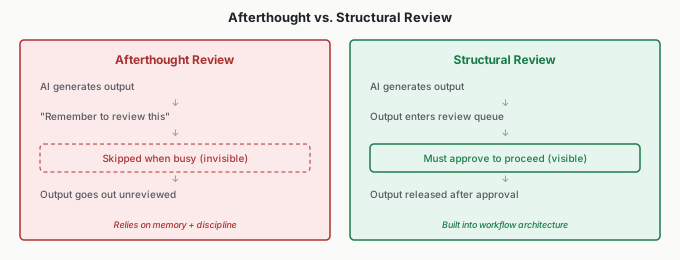
Why Afterthought Review Fails
Afterthought review relies on human memory, discipline, and available time. All three are unreliable under pressure.
The Discipline Problem
“I’ll review this before I send it” depends on you remembering to review it and choosing to spend time on review when other demands compete. Under time pressure—which is constant for most professionals—the review step is the first thing cut. It’s not urgent in the way that the next meeting or the waiting customer is urgent.
This isn’t a character flaw. It’s human nature. We prioritize immediate demands over quality checks. Review feels optional even when intellectually we know it’s important.
The Visibility Problem
Afterthought review is invisible when skipped. Nobody knows the review didn’t happen until an error emerges. By then, the damage is done—and it’s often unclear whether the failure was AI error, human error, or review failure.
When review is structural, skipping it is visible. The workflow shows review pending. The report sits in a queue. The bottleneck is obvious. This visibility creates accountability that afterthought review lacks.
The Ownership Problem
“Someone should review this” isn’t the same as “Jennifer reviews this before it goes out.” Diffuse responsibility means no responsibility. When review is everyone’s job, it becomes no one’s job.
Structural review assigns ownership. The workflow defines who reviews, when they review, and what happens if review doesn’t occur.
The Cost of Skipped Review
When afterthought review gets skipped, the costs extend beyond the immediate error:
Direct costs: Error correction, customer apologies, rework time, damaged deliverables.
Relationship costs: Client trust erosion, internal credibility damage, reputation impact that lasts beyond the incident.
Systemic costs: Once review skipping becomes normalized, quality degrades across the board. “It usually works” becomes the standard until something goes seriously wrong.
Career costs: AI errors carry your name. Review failure is accountability failure.
Structural review eliminates these costs by ensuring review happens rather than hoping it happens.
Review Points in Workflow Structure
The five-component workflow puts Human Review as component four—built into the structure, not added afterward. But where exactly should review happen? Different types of review serve different purposes.
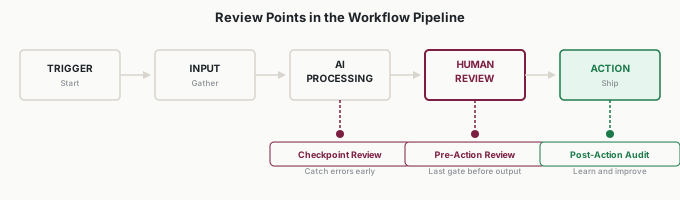
Checkpoint Review
Checkpoint review happens at defined stages within a workflow, before proceeding to the next stage.
What it does: Catches problems early, before they propagate. Prevents investment of additional effort in flawed outputs.
When to use: Complex workflows with multiple stages. Situations where early-stage errors cascade into later-stage waste. Workflows where course correction becomes expensive after certain points.
Example: An analysis workflow that gathers data, generates insights, and produces recommendations. Checkpoint review after the data gathering stage catches data quality issues before analysis proceeds. A second checkpoint after insights generation catches interpretation errors before recommendations are drafted.
Pre-Action Review
Pre-action review happens immediately before the workflow takes action—before the email sends, before the report distributes, before the recommendation goes to a decision-maker.
What it does: Provides the last opportunity to catch errors before consequences occur. Verifies that the output is appropriate for its destination.
When to use: Any workflow that produces external-facing outputs. Workflows where the action is difficult to reverse. Standard review for medium-stakes outputs.
Example: A proposal generation workflow that drafts client proposals. Pre-action review occurs before the proposal is sent—the reviewer confirms accuracy, appropriateness, and completeness before the client sees anything. This is the workflow’s quality gate; nothing crosses it without explicit approval.
Post-Action Audit
Post-action audit reviews outputs after they’ve already been actioned—not to prevent current errors, but to learn from patterns and improve future performance.
What it does: Identifies systematic issues. Provides calibration data. Catches errors for correction even if prevention was missed.
When to use: High-volume workflows where reviewing everything pre-action isn’t practical. Quality assurance for low-stakes outputs. Continuous improvement for any workflow.
Example: A social media workflow that generates daily posts. Post-action audit reviews a sample of last week’s posts: Were they accurate? Were they on-brand? What patterns emerge? Learnings feed back into the workflow.
Combining Review Points
For high-stakes outputs, use multiple review types:
- Checkpoint review catches issues early
- Pre-action review provides final verification
- Post-action audit enables continuous improvement
For low-stakes outputs, pre-action review or post-action audit alone may suffice.
Matching Review Points to Stakes
The review point architecture should match output stakes:
Critical outputs: Multiple review points. Checkpoint during production catches structural issues. Pre-action review catches final errors. Post-action audit enables continuous improvement. All three together provide maximum protection.
High-stakes outputs: At minimum checkpoint or pre-action review. Often both. Post-action audit valuable for calibration.
Medium-stakes outputs: Pre-action review at minimum. Post-action audit on a sampling basis for quality monitoring.
Low-stakes outputs: Post-action audit may be the primary review, with pre-action review reserved for items that seem unusual or problematic.
This gradient ensures that review investment scales with the consequences of errors.
Making Review Structural
Structural review doesn’t rely on memory or discipline. The workflow architecture ensures review happens.
Three Design Requirements
Review must be required. The workflow cannot complete without the review step. There’s no way to bypass review in normal operation. Emergency overrides exist but require explicit documentation and escalation.
Review must be assigned. Someone specific is responsible for review. Not “someone” but “Jennifer.” Not “the team” but “whoever is on review rotation this week.” Clear assignment prevents diffusion of responsibility.
Review must be timed. Review has a deadline. The workflow includes expected review duration. SLAs define what happens if review takes too long—escalation, reassignment, or alert.
Implementation Approaches
For manual workflows: Create physical stops. A checklist that requires checking before proceeding. A field that must be marked before the next step is possible. A second signature requirement for high-stakes items.
For semi-automated workflows: Build review queues. AI generates output; output goes to a review queue; workflow waits for approval before proceeding. Dashboards show what’s pending review. Notifications alert reviewers when items are waiting.
For fully automated workflows: Insert mandatory pauses. The automation stops at defined points and waits for human approval. Approval is required to continue. All reviews are logged automatically.
The Override Exception
Sometimes genuine emergencies require bypassing normal review. This should be possible—but visible and documented.
The override mechanism should: - Require explicit action (not default) - Log who overrode and when - Require justification - Trigger post-action audit automatically - Alert someone that standard review was skipped
Overrides are for emergencies, not convenience. If overrides become common, the workflow timeline needs adjustment, not the review requirement.
The Review Queue Concept
For semi-automated workflows, the review queue is a powerful structural element:
How it works: AI generates outputs; outputs automatically route to a queue; reviewers work through the queue; nothing leaves the queue without explicit approval.
Benefits: - Centralized visibility of what needs review - Clear accountability for review completion - Natural batching of similar items - Metrics on review throughput and delays
Implementation options: - Shared email folder for simple cases - Spreadsheet tracker for moderate complexity - Dedicated tool or dashboard for high-volume workflows - Integration with existing project management systems
The queue makes review visible, trackable, and unavoidable.
Review Efficiency
Structural review shouldn’t create bottlenecks. Design for efficiency.
Batching Reviews
Review similar outputs together rather than interspersed throughout the day:
- More efficient (less context-switching)
- More consistent (easier to compare items)
- Natural rhythm (review happens at defined times)
Set review windows: “Customer reports reviewed daily at 2 PM” rather than “Customer reports reviewed whenever someone remembers.”
Tiered Routing
Route reviews to appropriate reviewers based on stakes:
- Low-stakes outputs → Author self-review or peer review
- Medium-stakes outputs → Experienced team member review
- High-stakes outputs → Supervisor or specialist review
This prevents senior people from reviewing trivial items while ensuring important items get appropriate attention.
Time Limits and Escalation
Reviews need deadlines:
- Standard items reviewed within 4 hours
- Urgent items reviewed within 1 hour
- If deadline passes without review, escalate to backup reviewer
Time limits prevent items from languishing. Escalation ensures reviews happen even when the primary reviewer is unavailable.
Review Templates
For each workflow, define what review involves:
What to check: Specific elements requiring verification. Not “review for accuracy” but “verify customer name, account status, recommended actions, and tone.”
Pass/fail criteria: What makes a review pass? What triggers rejection? Clear criteria speed decisions.
Escalation triggers: What issues require escalation beyond the reviewer? Clear thresholds prevent hesitation.
Documentation requirements: What must be recorded? How? Where?
Templates make review faster and more consistent.
Building Review Capacity
Structural review requires review capacity—people with time and ability to review. Build this capacity deliberately:
Identify reviewers: Who has the expertise to review each workflow type? Who has the time? Who needs development in review skills?
Distribute load: Don’t concentrate all review on one person. Rotate responsibilities. Cross-train team members. Build backup capacity.
Allocate time: Review isn’t extra work squeezed into gaps. It’s scheduled work with protected time. If reviewers don’t have time allocated, review will fail regardless of structure.
Develop skills: Review is a skill that improves with practice. Provide feedback to reviewers. Share what gets caught and what slips through. Build institutional knowledge about effective review.
Review Documentation
I keep my review documentation simple: who reviewed, when, what was checked, and pass or fail. For low-stakes items, an email confirmation takes 10 seconds: “Reviewed and approved 2/20 - CG.” For high-stakes outputs, I use a checklist with specific items verified and any concerns noted.
The real value of documentation isn’t protection—it’s learning. After two months of tracking my reviews, I noticed a pattern: AI-generated engagement metrics were wrong roughly 15% of the time, while tone and formatting were almost always fine. That data let me calibrate: I could scan formatting quickly while spot-checking every number. Without the documentation, I would have reviewed everything at the same intensity and burned out again.
Build a feedback loop: weekly, scan for bottlenecks and unusual patterns. Monthly, look at what errors were caught versus what slipped through. This meta-review improves the entire system over time.
Applications
Mariana (Customer Success Director, B2B SaaS)
Mariana’s team of eight account managers used AI to generate weekly customer health reports. The original workflow had “review before distributing” as the last step—and three months in, reports were going out unreviewed. Her fix: she built a review queue in their shared project tracker. AI-generated reports landed in a “Pending Review” column. Account managers couldn’t move them to “Distributed” without checking three items: customer name and account tier correct, engagement metrics plausible, and recommended actions appropriate.
The structural change took 30 minutes to implement. Error escapes dropped to near zero within a week. More importantly, the review queue gave Mariana visibility she’d never had: she could see at a glance which reports were reviewed, which were pending, and who was falling behind. For department leaders, the review queue is the single most powerful structural element—it makes invisible review visible.
Kelly (Marketing Coordinator)
Kelly produced AI-assisted content daily: social posts, email drafts, blog outlines, and internal briefs. She’d been reviewing everything at the same intensity and hitting review fatigue by 2 PM. She restructured by adding different review points for different output types. Social posts got pre-action review (60-second scan before scheduling). Blog content got checkpoint review (verify facts after research synthesis, then verify voice after draft generation). Internal briefs got post-action audit only—she sampled three per week to check quality.
The tiered approach cut her daily review time from 90 minutes to 40 minutes. The blog content—her highest-stakes output—actually got better review because she wasn’t exhausted from scanning internal briefs. Kelly’s lesson for ICs: match your review architecture to your output stakes, not to a uniform standard.
Ben (Founder/CEO, 15-Employee Software Consultancy)
Ben had no review team. He was the reviewer. His AI workflow generated client proposals, SOWs, and project status updates. He couldn’t afford to review everything deeply, but he couldn’t afford errors in client-facing documents either. His structural solution: a two-tier system. Status updates went through a simple self-review checklist (client name, project name, milestone accuracy—90 seconds). Proposals and SOWs hit a mandatory 24-hour delay—the workflow scheduled them as drafts and pinged him the next morning for review with fresh eyes.
The delay was the key insight. Ben found he caught twice as many errors reviewing with a night’s distance than reviewing immediately after generation. The structural element wasn’t a queue or a team—it was a timer. For solo operators, building in delay is the simplest and most effective structural review mechanism.
Patricia (VP of Communications, Healthcare System)
Patricia’s team produced AI-assisted communications that reached 12,000 employees and external stakeholders. She implemented the most rigorous structural review in this chapter: checkpoint review at the research stage (verify all cited policies and statistics), pre-action review before distribution (tone, accuracy, legal compliance), and a documented override process for urgent communications that couldn’t wait for full review.
The override process was critical. In healthcare communications, some messages are time-sensitive—patient safety alerts, regulatory notifications. Patricia’s override required the sender to document why standard review was skipped, automatically triggered a post-action audit within 24 hours, and alerted Patricia directly. In six months, overrides were used 11 times. The post-action audits caught issues in two of those 11—both were corrected within hours. Without the override system, those messages would have either been delayed (dangerous) or sent unreviewed (risky). The structural approach gave her team a way to be both fast and safe.
Common Objections
“This adds overhead to every workflow.”
Review is already part of the workflow—the question is whether it happens reliably. Structural review doesn’t add time; it ensures that review time is actually spent. And it prevents the much larger time cost of error correction after problems escape.
“People will just rubber-stamp reviews.”
Possible, but now visible. Afterthought review that’s skipped is invisible. Structural review that’s rubber-stamped creates a record. If errors emerge from rubber-stamped reviews, accountability is clear. This visibility itself discourages rubber-stamping.
“Different workflows need different review structures.”
Exactly right—that’s why review is designed per workflow. The principle is universal: make review structural. The implementation is workflow-specific: what review points, what level of scrutiny, what documentation.
“This will slow everything down.”
Initially, perhaps. Structural review makes hidden review time visible, which can feel like adding delay. Over time, the system speeds up: fewer errors mean less rework, less damage control, less crisis management. The net effect is usually efficiency gain, not loss.
“We don’t have time to build all this infrastructure.”
Start simple. For your most important workflow, add one review checkpoint. Define who reviews. Create a simple documentation requirement. That takes an hour to design. Scale from there as you see benefits.
“What if the reviewer is the bottleneck?”
Then review is under-resourced or review scope is too broad. Solutions: add reviewer capacity, reduce review scope for lower-stakes items, implement tiered routing so not everything goes to the same reviewer, or streamline the review process itself. A bottleneck is a signal to optimize, not a reason to eliminate review.
“How do I know if structural review is working?”
Track metrics: How many items are reviewed? What percentage of reviews catch issues? What’s the average review time? How often do errors escape review? These metrics tell you whether review is happening and whether it’s effective. Without structural review, you can’t even track these metrics—review is invisible.
Your Monday Morning Action Item
For your primary AI workflow, add structural review:
Step 1: Identify the review point. Where should review happen? What action should it precede?
Step 2: Define the review scope. What specifically should be checked? Create a brief checklist.
Step 3: Assign the reviewer. Who is responsible? Who backs them up if they’re unavailable?
Step 4: Create the stop. What prevents proceeding without review? A required field? A routing step? A manual handoff?
Step 5: Define documentation. What record of review is required?
Then test: run the workflow five times this week. Did review happen every time? Was the process smooth or bottlenecked? Adjust based on experience.
Structural review transforms review from a hope into a reliable guarantee. Build the structure; the review follows.