Career Positioning
Two Candidates, Same Claim
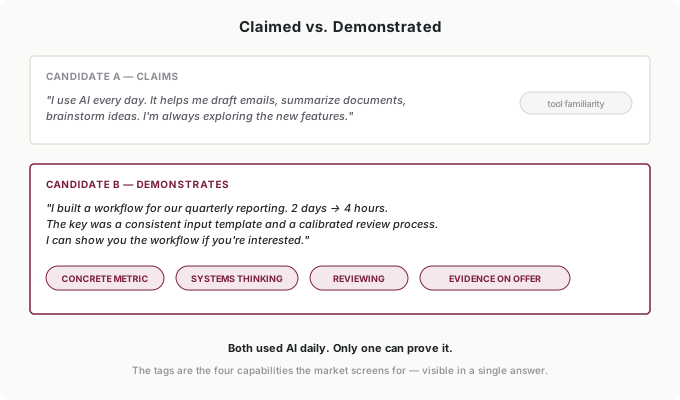
Two candidates interview for the same senior analyst role. Both résumés claim “AI experience.” Both have used AI tools daily for the past year.
The interviewer asks each the same question: “Tell me how you use AI in your work.”
Candidate A: “I use AI every day. It helps me draft emails, summarize documents, and brainstorm ideas. I’m always exploring the new features.”
Candidate B: “I built a workflow for our quarterly reporting process. Collecting data from five sources and drafting the report used to take 2 days; it now takes 4 hours. The key was a consistent input template and a calibrated review process. I can show you the workflow if you’re interested.”
Both candidates used AI daily. Only one demonstrated capability—and I can vouch for which answer works, because Candidate B’s answer is structurally what I say when a prospective client asks how I work. The workflow, the before-and-after hours, the offer to show rather than tell. It’s the answer that wins the engagement, every time.
The skills you’ve been building travel—across tools, across jobs. This chapter is about making them visible when they arrive: closing the gap between claiming AI experience, which everyone now does, and demonstrating it, which almost nobody can.
The Window
Most knowledge-work roles aren’t being eliminated by AI—they’re being augmented, and the augmented versions expect more. The analyst who can synthesize with AI does more valuable work than one who can’t. The consequence is quiet but brutal: meeting yesterday’s expectations with today’s tools isn’t success; it’s falling behind.
Right now, genuine AI proficiency still differentiates, because almost everyone claims it and few can demonstrate it. That won’t last. At some point, AI proficiency becomes like email—expected, invisible, and useless as a differentiator. Nobody gets hired for being good at email; everybody was expected to get good at it years ago. The window between exceptional and table stakes is where careers reposition, and it only moves in one direction.
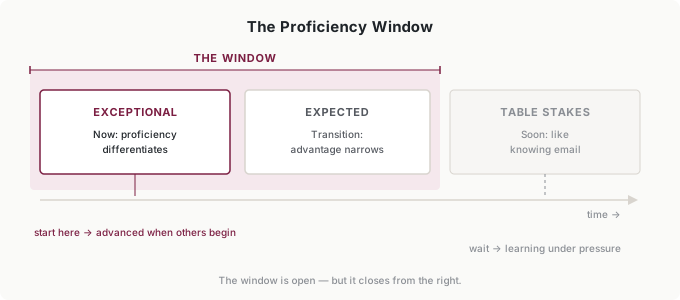
This isn’t a reason to panic—especially not for you. The window is urgent for people starting from zero, and you aren’t one of them: your capability-building took this whole book. What’s left is the cheap step—making it visible—and that takes an afternoon, not a year. Better to be ready and waiting than scrambling to catch up.
The Signal Broke
For your whole career, output has been evidence. Production was hard, so a finished deliverable proved effort; effort implied expertise; expertise implied worth. Every résumé, portfolio, and work sample rides on that chain—and nobody examined it, because it never failed.
AI snapped the first link. In Microsoft’s 2026 Work Trend Index—a survey of 20,000 AI-using knowledge workers across ten countries—58% said they’re producing work they couldn’t have a year ago. The polished analysis that once took a decade of skill now takes an afternoon and a subscription. And when everyone’s deliverable is polished, polish stops carrying information. A clean report no longer proves the author understood the problem. It proves they have access to AI—which everyone does.
The same survey shows where the signal went: 86% said they treat AI output as a starting point, not a final answer. The thinking is still human. The evidence that still means something is the trail the thinking leaves—what you noticed that the draft missed, which plausible approach you rejected and why, the risk you caught before it shipped. Knowledge work is producing more than it has ever produced and comprehending less of what it produces; the gap between those two curves is where you get paid.
What the Market Pays For
The screening is already happening, even where it isn’t formal. Interviewers ask the “tell me how you use AI” question and listen for shape, not tools. Managers notice which team members’ AI-assisted work ships clean and whose needs rework. Clients like mine compare the consultant who says “I use AI extensively” against the one who opens a workflow document. In every version, four capabilities are what’s being screened for—and they’re the skills you already have, framed as what they’re worth.
Judgment is knowing when not to use AI—the knowing-what-not-to-delegate skill, and the first thing I probe for when someone pitches me their AI experience, because it indicates wisdom rather than enthusiasm. The professional who can explain why they draft sensitive communications manually demonstrates more sophistication than the one who automates everything.
Reviewing is evaluating AI output fast and accurately. Anyone can generate content now; generation is free. Evaluation is the bottleneck, and the person who can reliably tell good from plausible is the person the output can be trusted to.
Domain expertise, amplified. AI capability alone differentiates nobody—it’s the combination that pays. An accountant who uses AI well is a more valuable accountant, not an “AI person.” Your domain knowledge is what makes your judgment worth anything.
Systems thinking is building infrastructure rather than executing tasks—workflows, templates, processes that outlive any single deliverable. It’s the difference between “I did this task with AI” and “I built the thing that does this task.”
How Much of Your Week Needs You
A job title is a costume: inside it are fifty, a hundred, sometimes three hundred small tasks wearing one name. AI doesn’t compete for the title—it competes for the tasks. “Will AI take my job?” is unanswerable, and paralyzing besides. The useful question fits on a calendar: how much of your last two weeks actually needed you?
Take your last ten business days and tag every meeting, document, and recurring task with one of four letters. Theater—it exists because the organization performs it: the status meeting that unblocks nobody, the deck nobody reads closely. Commodity—real, valuable work that doesn’t need you specifically: summarizing, routing, applying known rules. On the line—the uncomfortable middle, where a strong junior or a well-briefed AI could do most of it and the last stretch feels like judgment. Durable—your presence changed the outcome, in a way you couldn’t have fully briefed anyone else to produce.
Theater plus commodity is the fraction of your week on thin ice. The audit surprises almost everyone in the same direction—theater bigger than expected, durable smaller—because we conflate “professionally expected” with “value-creating.” The FFCC scorecard asked which tasks the intern could take. This audit asks the harsher question: what’s left of your week once it does?
If you’ve been running this book’s system, much of your commodity bucket has already gone to the intern. The finding that matters is where the recovered time went—into more commodity throughput, or into the durable work that compounds. The buckets compound to different owners: theater compounds to nothing, commodity compounds to the organization, durable compounds to you—calibration, pattern recognition, a judgment record nobody can copy.
Alongside skills, expertise, network, and track record, that compounding has created a fifth kind of career capital: the working context you’ve built with your AI systems. The folder is the portion you actually own, which is why you built it somewhere you control.
And if you own the company, run the audit on yourself anyway. Founders’ calendars grow theater too, and your durable bucket answers a question the business depends on: what does this company still need you for?
Your Folder Is Your Portfolio
Here’s the part the career-advice genre gets wrong: it tells you to build evidence. You don’t need to. If you’ve been running the system from the last few chapters, the evidence already exists—you’ve been building a capability portfolio all along without calling it one. Your résumé says “AI experience.” So does everyone’s. Your folder says something no résumé can.
Open your folder and look at it through a hiring manager’s eyes. The workflow library is portfolio content: documented, systematic, transferable. The error log is proof of calibration—here are the failure patterns I learned to catch, and here’s the review discipline that catches them. The knowledge base holds your judgment examples: decisions, rationale, the calls you made about when AI was and wasn’t the tool. The before/after metrics the genre tells you to “capture deliberately”? They’re in the workflow docs, because you wrote them down when the workflow earned its place.
The folder has one blind spot, and it’s the expensive one. Your best judgment leaves no artifact: the launch that didn’t fail, the client who didn’t churn, the AI draft that never shipped because you caught what was wrong with it. Good judgment, done well, looks like nothing happened—which is why performance reviews can’t see it and interviewers don’t know to ask.
Capture it in four lines while it’s fresh: the situation—what was at stake; the decision—what you chose, and what you rejected; the risk—what could have gone wrong, and what you consciously accepted; the change—what got safer, faster, or clearer because of the call. What you understood well enough to refuse says as much as what you shipped. And the record proves something no résumé can: you evaluated well and acted before anyone validated the call. The first is taste. The second is the part that can’t be added later.
What’s left is curation, and curation is a translation job: from your language to theirs. Business outcomes, not AI features—“increased team capacity by 40%” lands; “mastered the latest model” doesn’t. Judgment and calibration, not volume. And always include the boundaries: what you don’t use AI for, and why. In my experience, the boundary examples do more persuading than the wins, because they’re the part nobody can fake.
The translation is quick because the raw material is honest. A workflow doc that says “refund-triage: drafts responses, flags anything over $200, error rate under 2% since March” translates to one review bullet, one résumé line, and one interview answer with almost no rewriting. That’s the quiet payoff of documenting as you go—the version you wrote for yourself is nearly the version the world needs to see.
When I’m sitting across from a prospective client, the portfolio moment is never a slide. It’s opening a workflow document and walking through it: here’s the trigger, here’s the input template, here’s where review happens, here’s what it catches. The document does the arguing. Don’t tell them you use AI. Show them the workflow.
Making It Visible
Where you aim the evidence depends on where you’re positioning.
Inside your organization, visibility comes from contribution: share the approaches that work, help colleagues build their own workflows, volunteer when AI initiatives need hands, and make sure your quantified wins appear in your performance documentation—specific numbers, in the review, in writing, because review season memory is short and numbers survive it. Helping others is the quiet compounding move: it builds reputation and relationships simultaneously, and cross-functional AI help creates connections your org chart never would. One caution: don’t oversell—the colleague who overpromises on AI burns exactly the trust this approach builds.
In the market, the résumé line is the metric line: “developed an AI-assisted workflow that reduced report generation time by 70%” beats any tools list. One test for every line: would it survive an AI compressing you to two sentences against fifty candidates? Numbers survive compression; “extensive AI experience” averages into the pile. In interviews, be ready to demonstrate rather than describe—have the specific example with numbers, discuss a failure and what it taught you, and name what you don’t use AI for. That last one reliably lands hardest.
For your company, if you own one, the same gap is a sales gap. Every competitor’s site now says “AI-powered”—a claim that decayed exactly the way “AI experience” did on résumés, and for the same reason. What doesn’t decay is the walkthrough: a workflow document opened in a sales conversation, with the trigger, the review gate, and an error rate that carries a date. Prospects run the same screen interviewers do, and the firm that demonstrates instead of claims wins the engagement the way Candidate B wins the offer.
In leadership contexts, the register shifts from personal capability to organizational vision: how workflows scale across teams, what infrastructure enables adoption, how AI-augmented teams accomplish more without replacing anyone. The evidence changes shape too—less “here’s my workflow,” more “here’s the readiness gate my teams pass before anything rolls out, and here’s the adoption curve it produced.” Leaders get hired for the thoughtful-adopter reputation—strategic application with clear-eyed limitations—not for evangelism. In every leadership conversation I’ve watched, the person who could name what their org doesn’t let AI touch was taken more seriously than the person with the most pilots.
The Long Game
Career capital from AI capability compounds on three timescales. Experience accumulates into intuition that can’t be taught or quickly replicated—the pattern eye, the briefing instinct. Reputation compounds the slowest and pays the longest: being known as the person who uses AI thoughtfully—who ships the numbers and names the boundaries—generates recommendations and inbound opportunities for years after any specific workflow is obsolete. My consulting pipeline today is mostly people who watched a workflow walkthrough two years ago and remembered it when their own AI initiative stalled. And the whole asset is portable—the workflows may belong to your employer, but the skill of building them is yours, and it moves.
You already know which layer persists and which expires. The career corollary is worth adding: the persistent layer is also the demonstrable layer. Judgment, reviewing, and systems thinking show up in interviews and reviews in ways tool trivia never will. The prompt syntax you memorized is invisible on your worst day and worthless in two years; the workflow you can walk someone through is compelling in any year.
The ladder itself keeps moving, which is what single-skill career plans miss. First the scarce skill was prompting. Then it was delegation—briefing, reviewing, knowing what not to hand off. The next rung is already visible: ownership. Workflows, once built, need someone who keeps them honest—noticing drift, retiring stale ones, feeding the review loop—and the professional who keeps a staff of interns productive quarter after quarter will out-earn the one who writes a single brilliant brief, for the same reason a good manager out-earns a great task-doer.
The test for whether you’re climbing the right ladder is blunt: what do you still own if AI gets ten times better? Prompt tricks fail on contact. Judgment, calibration, and the record of both get more valuable—a ten-times-better intern raises the price of knowing what to hand it and whether to trust what comes back.
And even if you’re happy exactly where you are, the portfolio is optionality. Reorganizations happen. Opportunities appear. Demonstrated capability expands what you can say yes to—value that exists whether or not you ever spend it. The professionals who feel most secure right now aren’t the ones whose companies are safest; they’re the ones who could walk into any interview with a folder that does the talking.
Putting It Into Practice
Jordan is Candidate B
When Jordan interviewed for a senior role this year, the “tell me about your AI experience” question got a demonstration: the earnings-call workflow with its before/after hours, the speaker-attribution constraint that caught a misquote bound for a client memo, and—the moment the interview turned—his restart-call record. “I keep a log of my iterate-versus-restart decisions and how they aged. Most of my early calls were wrong. Here’s how the record fixed them.” He wasn’t reciting AI experience. He was exhibiting a judgment paper trail, and no one else in the pool had one. The preparation cost him 20 minutes, because every artifact already existed in his folder—he just chose which three to bring.
Elena’s review writes itself
Elena’s performance review used to require an evening of remembering. Now it’s an export: the team’s revision-rate trend from her error log, the brief-template adoption numbers, the two workflows her writers built under her gates. Her AI story isn’t a paragraph of claims—it’s three charts with dates. Her manager’s comment: “This is the first AI update I’ve read that contains numbers.”
Tomás sits on the other side
Tomás hires now with the question Ingrid taught him: “Tell me about a prompt you got better at.” What he listens for isn’t tools—it’s the shape of the answer. Candidates with real capability tell improvement stories with specifics: what failed, what they changed, how they knew it worked. Candidates without it list products. For a 15-person firm that can’t afford a bad hire, that one question has become his cheapest and most reliable filter. And it cuts both ways: the firm’s own positioning to clients now leads with the anomaly-check workflow—the artifact, not the claim—because Tomás learned from his own interviews what evidence sounds like.
Ingrid’s visibility is the brand
Ingrid never calls herself an AI leader, and that restraint is the strategy. Her Friday notes—skill focus, failures included—do the positioning for her: the executive who practices in public, and admits what she’s still bad at, reads as credible in exactly the way evangelists don’t. When the company needed someone to own the enterprise AI policy, nobody held a search. The reputation had already made the decision.
Common Objections
“My industry doesn’t value AI skills yet.”
Yet. Every knowledge-work domain is moving toward augmentation at different speeds, and the skills transfer across roles when yours catches up. Positioning early in a slow industry is the best version of the window—you get years of practice while the expectations are still forming, and you’ll likely be the person your industry’s expectations get calibrated against.
“I don’t want to be labeled ‘the AI person.’”
Right instinct, wrong worry. The positioning that works isn’t “AI expert”—it’s “domain expert who uses AI effectively.” A financial analyst with real AI capability is still a financial analyst, just harder to replace. The capability amplifies your expertise; it doesn’t rename you.
“How do I demonstrate skills without revealing proprietary work?”
Abstract the pattern, keep the specifics. A workflow’s structure—trigger, inputs, review, outcomes—demonstrates capability without a single confidential detail. My client walkthroughs never show client data; they show the shape of the thinking.
“AI skills will commoditize—there’s no lasting advantage.”
Basic use will, and fast—the models are already proving it. In June 2026, HashiCorp co-founder Mitchell Hashimoto ran the same routine coding task through three models and posted the results: a budget model did it for under a dollar, a mid-tier model for about a dollar fifty, the frontier model for nine. All three outputs were equally acceptable. On known work, the cheap intern now ties the expensive one.
His second experiment is the one to remember. He handed the frontier model a systems-optimization problem he’d written himself—a task on no backlog anywhere—and two hours and forty dollars later it reached a level he said he couldn’t have hit on his own. The forty dollars wasn’t the skill; knowing the problem was worth forty dollars was. That’s why the expert gap survives the rising baseline: judgment, reviewing, and systems thinking are the expensive tier, and they’re expensive precisely because they take deliberate practice most people won’t do.
There’s a pattern here worth trusting, because it runs the opposite way from the fear: standardization doesn’t erase the individual—it isolates them. Surgery is the clearest case. It’s one of the most standardized, checklist-driven fields we have, and when expert panels scored bariatric surgeons from operating-room video, the least-skilled quartile had nearly triple the complication rate and five times the mortality of the most-skilled—same procedure, same checklists. The protocols strip out every other source of variation until the surgeon’s own judgment is what’s left to explain the outcome. The same thing shows up in the corner office: the measurable “CEO effect” on company performance has been climbing for six decades, not fading, even as management grew more systematized. When the tools converge, the person using them becomes the variable that matters more, not less. AI is the most powerful standardizing force knowledge work has ever met—which is a reason to build judgment now, not a reason to assume it won’t count.
“I’m too senior to learn new technical skills.”
This was never a technical skill. It’s judgment applied to a new employee, and judgment is what seniority is made of. You have more domain knowledge to amplify, more context for the boundary calls, and more credibility when you demonstrate thoughtful application. Seniority is an advantage here, not an obstacle.
Your Monday Morning Action Item
Assemble—don’t create. This week, pull three items from your folder and translate them for an outside audience:
One workflow document, rewritten as you’d say it in an interview. Five slots: the task, the workflow, the before/after number, what the review process catches, and what you deliberately don’t automate. That skeleton is Candidate B’s answer—and it’s the same one that wins client work; only the audience changes.
One judgment example from your knowledge base, written as the four-line record: situation, decision, risk, change. This is the artifact competitors won’t have—especially the risk line, because avoided damage is evidence almost nobody thinks to keep.
One metric sentence you could say in a performance review or interview without notes: “I’ve developed a systematic approach to [task] that improved [outcome] by [number].”
Store the translated versions in the folder alongside the originals—the portfolio wing of the system you already keep, one directory over from the workflows it describes. Then keep the habit: every workflow that earns its place gets its interview version written while the numbers are fresh.
Everyone claims AI skills now. Your job is to prove yours are real.