Scoring Your Opportunities
The Sexy Project I Almost Built First
The project I wanted to build first was campaign strategy support. I’d just started with the client—a direct-to-consumer health brand—and the strategy work was the sexy option: AI-assisted competitive analysis, market positioning, the kind of thing you’d announce at an all-hands. It sounded like the future. I would have loved to demo it.
Meanwhile, 72,000 messages a month were piling up across SMS, email, Facebook Messenger, and Instagram, and nobody wanted to talk about the queue. Message triage was boring. Nobody demos an inbox.
Then I scored both, using the framework this chapter teaches. Strategy support failed almost every dimension that predicts success: quarterly-at-best cadence, expensive mistakes with no safety net, success criteria I couldn’t define past “the client nods.” It scored 12. The boring queue scored 500—work that arrived every hour, mistakes a reviewer could catch in seconds, categories I could specify precisely, a workflow I could isolate and iterate.
I built the queue. That 500-score workflow became the system that anchored $700,000 in booked contract value in 90 days. The strategy deck I never built wouldn’t have anchored anything.
This is the prestige trap. We gravitate toward AI applications that sound important rather than ones that work well. You mapped your decisions; now you need a scoring system to tell which ones are actually good AI candidates—and which will waste your time despite sounding promising.
The framework is called FFCC—Frequent, Forgiving, Clear, Contained. It’s not complicated, but it’s counterintuitive. It will almost certainly tell you to start somewhere different than your instincts suggest. That’s the point.
Why Your Instincts Will Mislead You
When choosing where to apply AI, most people make three predictable mistakes.
We overweight rarity. That quarterly strategic analysis feels more important than daily email processing. It’s special. It goes to executives. It deserves AI help. But rarity is the enemy of AI learning—you need frequency to iterate and improve. I felt this pull myself: the strategy work felt like consultant work; the message queue felt like grunt work. The queue was where the money was.
We underweight volume. Ten minutes saved daily doesn’t feel significant. Two hours saved quarterly feels substantial. But the math tells a different story:
- 10 minutes/day × 250 workdays = 41 hours saved per year
- 2 hours/quarter × 4 quarters = 8 hours saved per year
The “trivial” daily savings delivers 5x more value than the “substantial” quarterly savings.
We ignore failure modes. When imagining AI assistance, we picture it working perfectly. We don’t imagine the confident errors, the hallucinated details, the subtle mistakes that require extensive review. Tasks where errors are catchable and consequences are minimal make better starting points than tasks where errors are expensive.
The FFCC framework counteracts these instincts. It forces you to score opportunities on dimensions that actually predict success rather than dimensions that feel important.
Think of it as a filter for the decision map you just built. You identified where you make decisions. Now you need to know which of those decisions are good AI candidates. The scoring reveals what your intuition hides.
I’ve seen teams waste months on low-scoring tasks because they seemed strategic—a quarter spent on an AI proposal generator that quietly died is the classic version—while high-scoring tasks sat ignored because they seemed trivial. The framework prevents that mistake.
The FFCC Framework
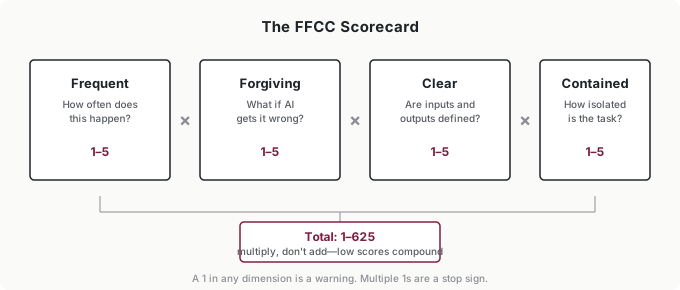
FFCC stands for Frequent, Forgiving, Clear, Contained. Each dimension captures something important about whether an AI workflow will succeed or struggle.
Frequent
The question: How often does this decision or task occur?
Why it matters: Frequency determines ROI. A workflow you use daily generates 250 times more value annually than one you use annually. But frequency delivers a second, subtler benefit: more learning cycles. When you use a workflow daily, you iterate daily. You discover what works, refine your prompts, catch failure modes—all faster than if you’re only touching the workflow quarterly. My first workflow touched messages that arrived every hour of every day; I got more learning cycles in its first week than a quarterly task would have given me in a year.
How to score it:
| Score | Frequency |
|---|---|
| 5 | Multiple times daily |
| 4 | Daily |
| 3 | Weekly |
| 2 | Monthly |
| 1 | Quarterly or less |
Forgiving
The question: What happens if AI gets it wrong?
Why it matters: All AI makes mistakes. That’s not a bug—it’s the fundamental nature of probabilistic systems. The question isn’t whether errors will occur; it’s whether errors can be caught and corrected before they cause damage.
Forgiving tasks have built-in safety nets. An internal draft that goes wrong gets fixed before anyone outside the team sees it. An email subject line that underperforms gets replaced in the next campaign. Contrast this with a contract clause that’s wrong but goes unnoticed, or medical advice that a patient acts on before anyone reviews it. In my triage workflow, a misrouted message cost seconds to fix—a human reviewed everything before it shipped. That safety net is why I could afford to let the system learn.
How to score it:
| Score | Error Consequences |
|---|---|
| 5 | Errors caught easily, no external impact (internal drafts, personal research) |
| 4 | Minor rework required, limited visibility (team documents) |
| 3 | Moderate correction needed, some external visibility (client communications with review) |
| 2 | Significant consequences if missed (financial reports, legal documents) |
| 1 | Severe or irreversible consequences (medical advice, safety-critical systems) |
Clear
The question: Are inputs and outputs well-defined?
Why it matters: AI performs best with clear specifications. “Make this better” produces inconsistent, often unusable results. “Summarize this meeting in 3 bullet points highlighting action items, decisions made, and open questions” produces something you can actually use.
Clarity isn’t just about prompting skill—some tasks are inherently clearer than others. A task with an existing template, defined format, and concrete success criteria is clearer than one that requires judgment about what “good” means in each situation. By the time I built my first workflow, I’d read 12,000 customer messages by hand. I could tell the AI exactly what each category looked like—that’s what a 5 on Clear feels like.
How to score it:
| Score | Clarity Level |
|---|---|
| 5 | Explicit format, clear criteria, examples available |
| 4 | Defined structure, most parameters clear |
| 3 | General expectations clear, some ambiguity |
| 2 | Significant interpretation required |
| 1 | “I’ll know it when I see it” |
Contained
The question: Can this task be isolated from other systems and processes?
Why it matters: Dependencies create complexity. If an AI workflow requires integration with five systems, approval from three stakeholders, and coordination with two teams, problems multiply at every junction. Contained tasks can be improved without disrupting everything else. You can iterate faster, fix problems more easily, and prove value before expanding scope.
How to score it:
| Score | Containment Level |
|---|---|
| 5 | Fully self-contained, no dependencies |
| 4 | Minimal dependencies, clear handoff points |
| 3 | Some integration required, manageable scope |
| 2 | Multiple dependencies, coordination needed |
| 1 | Deeply embedded in complex workflows |
How to Use the Scorecard
- List 5-10 opportunities from your decision map
- Score each on all four dimensions (1-5)
- Multiply to get the total: Frequent × Forgiving × Clear × Contained
- Rank by total score
- Validate against business context
The multiplication matters. A task that scores 5/5/5/5 gets a perfect 625. A task that scores 1/5/5/5 gets only 125—still reasonable. But a task that scores 1/1/2/2 gets only 4. The framework heavily penalizes tasks that score low on multiple dimensions.
This is intentional. A task that’s infrequent AND unforgiving AND unclear AND embedded in complex workflows is almost guaranteed to fail as an AI starting point. The multiplication catches these combinations; addition wouldn’t. A 1 in any dimension is a warning. Multiple 1s are a stop sign.
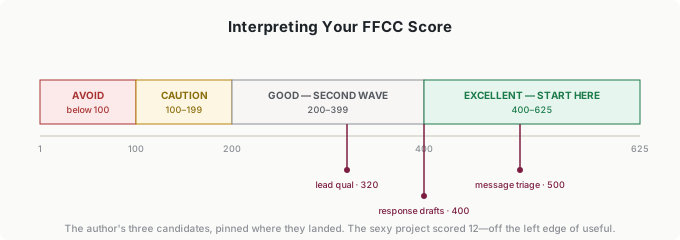
When I ran this on my own list for the health-brand client, the ranking embarrassed my instincts:
| Opportunity | Frequent | Forgiving | Clear | Contained | Score |
|---|---|---|---|---|---|
| Social media message triage | 5 | 5 | 5 | 4 | 500 |
| Customer response drafting | 5 | 5 | 4 | 4 | 400 |
| Lead qualification | 5 | 4 | 4 | 4 | 320 |
| Campaign strategy support | 1 | 2 | 2 | 3 | 12 |
The top three all cleared 300—which raised its own problem, choosing among close scores, and that’s the next chapter’s job. The bottom row is the sexy project from the top of this chapter, scored honestly.
Interpreting Your Scores
| Score Range | What It Means |
|---|---|
| 400-625 | Excellent candidate—start here |
| 200-399 | Good candidate—consider for your second wave |
| 100-199 | Proceed with caution—validate thoroughly before investing |
| Below 100 | Avoid for now—revisit when you have more AI experience |
The Business Value Check
High FFCC score alone isn’t enough. A task could score 625 but contribute nothing to your goals. After ranking by FFCC, ask three questions:
- Does this decision actually affect outcomes I care about?
- Will success here build momentum for larger initiatives?
- Is this aligned with current priorities?
High FFCC + High Business Value = Best starting point. The scorecard tells you what’s likely to succeed. Business judgment tells you what success is worth.
A task that scores 625 but has zero business impact is a waste of time. A task that has massive business impact but scores 16 is setting yourself up for failure. You need both: high suitability AND meaningful value. My triage queue scored high on both—highly suitable, and sitting directly on top of revenue. That combination is what you’re hunting for.
What if your highest-scoring task has low business value? Either reconsider whether you’re undervaluing routine efficiency gains (often people do), or look for a task that scores in the 200-400 range with higher impact. The goal is the best combination, not the highest score alone.
Putting It Into Practice
The four people below are composites—details changed, patterns real. I’ve watched each of these scoring sessions play out more than once.
Hugo manages HR for a manufacturing company
His instinct said to start with compensation analysis—high visibility, executive attention, strategically important. But he scored his opportunities:
| Opportunity | Frequent | Forgiving | Clear | Contained | Score |
|---|---|---|---|---|---|
| Job posting drafts | 4 | 5 | 5 | 5 | 500 |
| Interview debrief summaries | 5 | 4 | 4 | 4 | 320 |
| Policy question responses | 5 | 3 | 3 | 4 | 180 |
| Quarterly comp analysis | 1 | 2 | 2 | 2 | 8 |
His “strategic” comp analysis scored 8. His “mundane” job postings scored 500.
Hugo started with job postings. Draft time dropped from about 45 minutes to about 10 per posting. The high frequency—multiple postings per week—meant rapid learning. He refined his prompts through dozens of iterations in the first month alone. After three months, he approached comp analysis differently: AI handled the research sub-tasks (summarizing market data, identifying outliers) while strategic judgment stayed human.
Devon is a project manager at a marketing agency
Devon manages a dozen client projects. The biggest pain point felt like monthly client presentations—3-4 hours each, 12 clients, 40+ hours monthly. AI-generated presentations sounded like the kind of thing you put on a slide.
| Opportunity | Frequent | Forgiving | Clear | Contained | Score |
|---|---|---|---|---|---|
| Daily status update drafts | 5 | 5 | 5 | 5 | 625 |
| Meeting note summaries | 5 | 4 | 4 | 4 | 320 |
| Client email drafts | 4 | 3 | 3 | 4 | 144 |
| Monthly presentations | 2 | 2 | 2 | 2 | 16 |
Presentations scored 16. Status updates scored 625. Devon started with status updates despite feeling like it was “too easy to bother with.” Result: roughly 10 hours saved a week. The concentrated pain of presentations had masked the distributed drain of daily updates.
Ava is CEO of a 30-person logistics company
Ava wanted AI to help with strategic planning—competitive analysis, market positioning, growth scenarios. Important work, but she scored it honestly:
| Opportunity | Frequent | Forgiving | Clear | Contained | Score |
|---|---|---|---|---|---|
| Driver schedule summaries | 5 | 5 | 5 | 5 | 625 |
| Customer complaint triage | 5 | 4 | 4 | 4 | 320 |
| Vendor contract review | 2 | 2 | 3 | 3 | 36 |
| Strategic planning research | 1 | 2 | 1 | 1 | 2 |
Strategic planning scored 2. Driver schedule summaries scored 625. Ava started by having AI consolidate her three dispatchers’ daily schedule updates into a single morning briefing. Within two weeks, she was catching route conflicts she used to miss entirely. The quick win gave her confidence—and the time savings gave her space to think more strategically without needing AI to do the thinking for her.
Owen is VP of Customer Success overseeing four regional teams
Owen’s instinct was to use AI for churn prediction—the board wanted it, and it sounded like exactly the kind of strategic initiative a VP should champion. But the FFCC scores told a different story:
| Opportunity | Frequent | Forgiving | Clear | Contained | Score |
|---|---|---|---|---|---|
| Support ticket categorization | 5 | 5 | 5 | 4 | 500 |
| Weekly team report synthesis | 4 | 5 | 4 | 5 | 400 |
| QBR deck research prep | 2 | 3 | 3 | 3 | 54 |
| Churn prediction modeling | 1 | 1 | 2 | 1 | 2 |
Churn prediction scored 2—infrequent, unforgiving (wrong predictions erode trust with the board), unclear inputs, deeply embedded across CRM, billing, and product usage systems. Support ticket categorization scored 500. Owen started there, built a workflow that auto-tagged incoming tickets by product area and urgency, and within a month, critical tickets that used to sit for hours were getting picked up in minutes. When he eventually pitched churn analysis to the board, he had a track record of AI wins to back it up.
The pattern across all four: what feels like the biggest problem isn’t the best place to start. Pain intensity and AI suitability are different dimensions. The FFCC framework measures suitability, not pain.
Common Objections
“The highest-scoring tasks feel too mundane.”
That’s the point. Mundane, frequent tasks compound into massive time savings—and simple means you’ll get wins quickly, learn what works, and build momentum. Complex tasks that score low consume time, produce ambiguous results, and risk convincing your organization that AI doesn’t work. Start simple, succeed visibly, then graduate to the prestigious projects with a track record and developed skills. The sequence matters more than the starting point’s impressiveness.
“My most important decisions score low.”
Important and AI-suitable are different qualities. Some decisions score low precisely because they’re complex, rare, or high-stakes—which is why they need human judgment rather than AI automation. The framework working correctly means identifying what shouldn’t be automated, not just what should.
“What if two opportunities have similar scores?”
Go with the one where you have more control over the workflow. Lower dependency means faster iteration. Faster iteration means faster learning. When scores are close, break ties with containment.
“Should I ever start with a low-scoring opportunity?”
Only if there’s a compelling strategic reason—urgent deadline, executive priority, proof of concept for funding. Even then, set expectations that it will be harder and success is less certain. Low scores don’t mean impossible; they mean higher risk and lower likelihood of clean wins.
“My boss wants me to start with something impressive, not mundane.”
Use the scorecard to have that conversation. Show the math: daily status updates at 625 versus quarterly reports at 24. Explain that starting with high-scoring tasks builds the capability that makes impressive tasks possible. Frame mundane wins as the foundation for strategic ones.
“Can I improve a task’s score by changing how I do it?”
Sometimes. A low-clarity task might become clearer if you create templates first. A low-containment task might become more contained if you establish better handoff points. But be honest about whether you’re actually changing the task or just inflating scores to justify what you wanted to do anyway. The framework works when you score honestly.
Your Monday Morning Action Item
Take your three starred decisions from the 10-Decision Sprint.
Score each on FFCC: - Frequent: How often? (1-5) - Forgiving: What if AI’s wrong? (1-5) - Clear: Are inputs/outputs defined? (1-5) - Contained: Can it be isolated? (1-5)
Multiply to get total scores.
Your highest-scoring opportunity is your pilot candidate—two chapters from now, you’ll build it into your first workflow. But the scoring also tells you what to watch for:
- Low “Forgiving” score? Build extra review processes.
- Low “Clear” score? Expect more prompt iteration.
- Low “Contained” score? Map dependencies before starting.
The FFCC scorecard doesn’t just tell you where to start—it tells you what challenges to anticipate once you do.
The framework might tell you something different than your instincts suggested. That’s not a bug—it’s the framework doing its job. Trust the scores, not your desire for impressive-sounding projects. Mundane wins first, prestigious wins later.