Choosing Where to Start
The Two-Week Decision That Cost Six Weeks
When I scored my own opportunities, three came back above 300. Social media triage scored 500. Customer response drafting scored 400. Lead qualification scored 320. The top score wasn’t even close—and I still spent two weeks second-guessing it, reweighing criteria, asking colleagues what they thought.
Then I just picked the top scorer and started. Within two weeks I had saved enough hours to know the framework worked. Within a month, I had moved on to opportunity number two. Those two weeks of hesitation taught me nothing. The two weeks of doing taught me everything.
I see this pattern constantly. The typical version looks like this: someone spends six weeks choosing among three close-scoring opportunities—a decision the scores settled in the first two—and finally commits to the same one that scored highest from the beginning. Meanwhile, the person who just picked their top scorer and started is already on their second workflow.
At some point, choosing matters more than choosing perfectly. You mapped your decisions. You scored them with FFCC. The hard thinking is done. What remains is committing—and not choosing is its own choice, almost always worse.
When the Scorecard Isn’t Enough
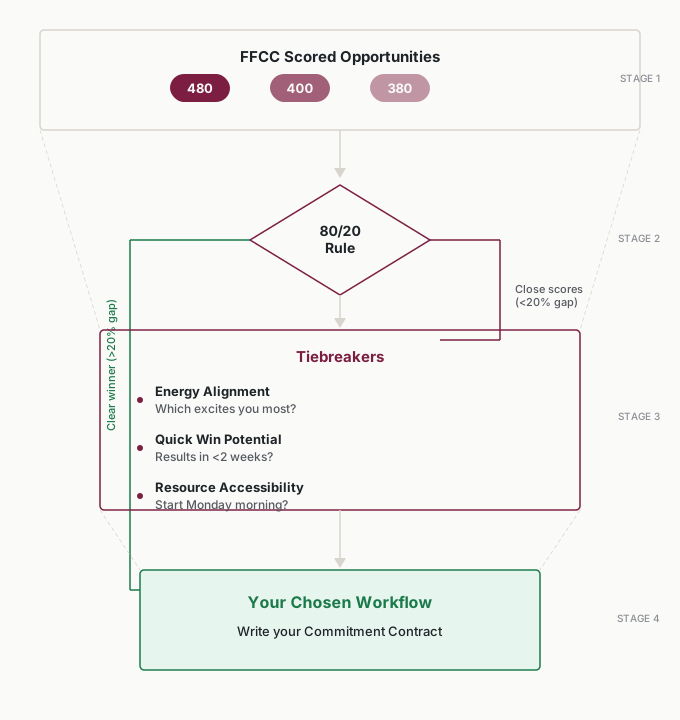
The FFCC framework does most of the work. Most of the time, it produces a clear winner. But sometimes you end up with multiple opportunities scoring similarly, and the scorecard alone can’t decide.
That’s when you need tiebreakers—factors that matter but that FFCC does not measure.
Tiebreaker 1: Energy Alignment
Which opportunity are you most curious about?
Motivation compounds. You’ll iterate more with work that interests you. You’ll persist through the inevitable early friction. You’ll pay attention to what’s working and what isn’t, rather than just going through the motions.
Between two equal FFCC scores, pick the one that feels more interesting. The one you are more curious to try. The one you’d rather spend your learning cycles on.
This isn’t about passion—it’s about engagement. A lower-scoring opportunity that holds your attention will outperform a higher-scoring one that bores you.
I’ve watched this pattern play out: two people with similarly-scored opportunities, one choosing on pure FFCC scores, the other on curiosity. Months later, the curiosity-driven choice has evolved into a sophisticated workflow while the “optimal” choice has been abandoned after a few weeks of half-hearted effort. Energy compounds over time.
Tiebreaker 2: Quick Win Potential
Which opportunity can show results in two weeks or less?
Early wins build momentum. They prove to you (and anyone watching) that AI actually works in your context. They give you the confidence and credibility to push further.
Some opportunities show results immediately—you save time on the first instance. Others require setup, learning curves, or volume before results become visible.
When scores are close, lean toward quick visibility. A small win this week beats a larger theoretical win next month.
Quick wins generate data. You learn what works, discover unexpected obstacles, refine your approach. All of that compounds. A slow-building opportunity could produce more value, but you will not know until much later—and by then you’ve invested significant time.
Tiebreaker 3: Resource Accessibility
Which opportunity can you start with what you already have?
If one option requires new software, multiple approvals, or extensive training while another can start with tools already on your laptop, start with what’s accessible.
I learned this one the hard way. My first AI workflow could have been a sophisticated customer analytics dashboard that required API access, data warehouse permissions, and a month of setup. Instead I started with something I could build in an afternoon: a prompt that summarized incoming messages and flagged the ones needing human attention. No special tools. No approvals. Just me and a chat interface. That “simple” workflow became the foundation for everything that followed—because I started learning immediately instead of waiting for perfect conditions.
The hidden cost of better tools is delay. Every day spent waiting for access is a day not learning. Simple tools you have now beat sophisticated tools you’ll get eventually.
The Monday Morning Test
Ask yourself: Can I start this workflow on Monday morning with tools I already have access to?
If yes, there’s no barrier except your own hesitation. Start.
If no, list what needs to happen first. Be specific—is it a tool you need? Approval? Data access? Training? Then either address those prerequisites this week, or pick a different opportunity that passes the Monday morning test.
The 80/20 Decision Rule
When scores are close, apply this rule: if your top opportunity scores within 20% of your second-place option, just pick the top one and move on.
The benefit of choosing perfectly never exceeds the cost of delayed action.
Examples:
- Top scorer: 500, Second: 400 → 500 is 125% of 400. Clear choice—pick 500.
- Top scorer: 350, Second: 320 → 350 is 109% of 320. Close enough—use tiebreakers.
- Top scorer: 400, Second: 380 → 400 is 105% of 380. Too close to matter—either works.
When scores are within 20% of each other, the framework has done its job by eliminating poor options. Any of your top scorers will work. The choosing phase should end here.
The Commitment Contract
Once you choose, write it down. Specific, concrete plans outperform vague intentions—research on implementation intentions has shown this repeatedly—and writing your commitment down forces that specificity.
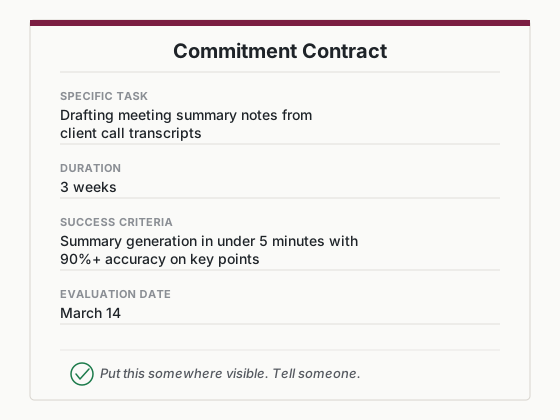
Your commitment contract needs four elements:
1. The specific task: “My first AI workflow is: [exactly what you’ll do]”
2. The duration: “I will try this for: [2-4 weeks minimum]”
3. The success criteria: “Success looks like: [specific, measurable outcome]”
4. The evaluation date: “I will evaluate on: [specific date]”
Example commitment contract:
“My first AI workflow is: drafting meeting summary notes from client call transcripts. I will try this for 3 weeks. Success looks like: summary generation in under 5 minutes with 90%+ accuracy on key points. I will evaluate on March 14.”
Put this somewhere visible. Tell someone if accountability helps. “I should try AI for something” becomes “I’ll get to that eventually” becomes “I never really committed to that anyway.” A written commitment with specific dates and metrics resists that drift. When you’ve written “I’m evaluating on March 14,” you’re less likely to abandon ship on March 8 because you had one frustrating session.
Context Matters: Solo vs. Team
How you choose depends partly on whether you’re implementing alone or with others.
Individual Contributors
You’re the only stakeholder. This simplifies everything:
- No permission needed (within your role boundaries)
- No coordination required
- You can change course quickly if something isn’t working
- Failure affects only you
For individual contributors, the choosing phase should be as short as possible. Run the framework, apply tiebreakers if needed, make the call. The learning happens in doing, not deciding.
Department Heads
You have additional considerations:
- Consider piloting with one team member before rolling out wider
- Choose a task visible enough to demonstrate value but contained enough to limit risk
- Plan for knowledge sharing once the workflow proves successful
- Keep initial scope small: one person, one task, one workflow
For department heads, the first win matters more than the best win. Build credibility before building scope.
Setting Up for Success
Before you start, define your pilot parameters:
Duration: 2-4 weeks minimum. Anything shorter doesn’t give enough learning cycles. You need time to iterate, encounter edge cases, and stabilize the workflow.
Volume: At least 10-20 instances of the task. You need pattern recognition—what works, what fails, what needs adjustment. A handful of uses won’t give you that.
Metrics: What will you measure? Time saved is the obvious one, but also consider: quality of output, effort required for review, error rate, your own energy and satisfaction.
Exit Criteria
Decide in advance when to continue, pivot, or stop:
Continue: Success metrics met, energy still high, clear path to expanding.
Pivot: Some value but not enough—try a different opportunity from your scored list.
Stop: Clear failure, overwhelming obstacles, or better opportunities have emerged.
Having exit criteria prevents both premature abandonment and sunk-cost persistence. Define “stop” conditions in advance so you don’t keep grinding on something that isn’t working. Define “continue” conditions so you don’t quit too early because of normal early friction. Make those calls now, not in the moment when emotions are running high.
Two Paths to a First Win
The Consultant’s Quick Choice
Farah, an independent consultant, scored four opportunities. Meeting summaries scored 400; email drafts scored 375. She spent two weeks hesitating, reconsidering, looking for certainty.
Then she recognized the pattern: perfectionism disguised as thoroughness. She applied the 80/20 rule: 400 vs. 375 was under a 7% difference. Either would work. She applied the energy tiebreaker: meeting summaries felt more interesting—she was curious whether AI could capture nuanced client conversations.
She wrote her commitment contract and started the next Monday.
By day five, she’d saved 4 hours across three meetings. By week two, she’d refined her prompts and expanded to all client meetings. The skills she developed transferred directly to her next opportunity.
Her reflection: “I spent two weeks deciding and two weeks implementing. I should have spent zero weeks deciding and four weeks implementing.”
By week three, Farah had already started applying similar techniques to email drafts—her second-highest scorer. The skills transferred. The momentum carried. Starting fast meant progressing fast.
The Team Lead’s Calculated Start
James, an IT support manager, faced a different challenge. His organization was skeptical of AI after a previous initiative had failed. Three opportunities scored above 400, all close enough to justify starting.
He applied the accessibility tiebreaker with a political lens: which success would position him for future opportunities?
Client-facing status updates scored slightly higher but required compliance approval and carried reputational risk. Internal ticket summaries could be piloted quietly, measured objectively, and documented as evidence for future proposals.
He chose internal summaries. After four weeks of documented success—140 tickets, 12 hours saved, zero quality issues—his director invited him to pilot client communications. The internal win created permission for the external opportunity.
His reflection: “I wanted to go straight to the impressive stuff. But starting smaller built the credibility that made bigger wins possible.”
Farah could move fast because she was the only stakeholder. James needed to move strategically because organizational trust was at stake. Both made good choices—but “good” looked different in each context. What they shared: both stopped analyzing and started doing.
Applications
Farah (Independent Consultant)
Farah’s story above shows the IC path: no stakeholders to convince, no approvals to wait for. She applied the 80/20 rule to a score gap of under 7%, used the energy tiebreaker to pick meeting summaries, wrote a commitment contract, and started Monday. By week three she had transferred her skills to her second opportunity.
James (IT Support Manager)
James faced organizational skepticism after a previous AI failure. He chose the accessibility tiebreaker with a political lens—internal ticket summaries over client-facing updates. After four weeks of documented success (140 tickets, 12 hours saved, zero quality issues), his director invited him to pilot the higher-stakes option. The internal win created permission for the external opportunity.
Carla (Founder/CEO, 18-Employee Design Studio)
Carla scored three opportunities within 15% of each other. As the founder, she had full authority to start anywhere—but limited time to run the pilot herself. She applied the Monday Morning Test and eliminated two options that required tools she didn’t have yet. The winner: proposal drafting. She already had all the inputs (client briefs, past proposals, pricing templates) on her laptop. She started that afternoon, and within a week had cut proposal creation time from three hours to 45 minutes. Her lesson: when you’re the founder, start with the task you personally do most often. You’ll iterate faster because you understand the quality bar.
Grant (VP of Sales, Enterprise Software)
Grant’s challenge wasn’t picking his own workflow—it was deciding which of his four regional managers should pilot AI first. He scored the regions using a modified FFCC framework: which team had the clearest data access, the most repetitive tasks, and a manager willing to champion the experiment? His Southwest team scored highest on all three. He wrote a commitment contract for the team, not just himself: “Southwest region will pilot AI-assisted pipeline reviews for four weeks, measuring forecasting accuracy and prep time.” The pilot succeeded, and Grant used the documented results to roll out across all four regions. For senior leaders, choosing where to start often means choosing who starts.
Common Objections
“What if I choose wrong?”
You’ll learn faster by starting than by analyzing. Even a “wrong” choice teaches you about AI workflows—what prompts work, what review processes help, how to iterate. Worst case, you pivot after two weeks with useful experience. Paralysis teaches nothing.
“I have constraints that limit my choices.”
Work within them. If you can’t access certain data or tools, score those opportunities lower and move on. Constraints are real—work around them rather than wishing them away.
“My top opportunity requires setup I don’t have time for.”
Pick your second-highest scorer that requires no setup. Getting started matters more than starting perfectly. You can always return to the higher-scoring option once you’ve built momentum and capability.
“What if success creates expectations I can’t meet?”
Define scope explicitly from the beginning. “I’m piloting AI for meeting summaries” doesn’t promise organization-wide transformation. Start small, communicate clearly, expand only when ready.
“Everyone on my team has different opinions about where to start.”
That’s actually a sign you have multiple good options. Use the FFCC scores as a tiebreaker. If opinions still differ, pick the option with the highest scorer and clearest ownership. One person pilots, learns, then shares. Starting anywhere beats debating everywhere.
“I’m worried about failing publicly.”
Start with something low-visibility. Internal tasks, personal productivity, behind-the-scenes work. Build a track record before going visible. Most failures happen in private and teach valuable lessons. Most successes can be made public later.
“The opportunity I want to try doesn’t score highest.”
If it’s close (within 20%), energy matters more than pure score. If it’s not close (your preferred option scores significantly lower), ask yourself why you’re drawn to it. Sometimes it’s legitimate insight the framework missed. Sometimes it’s the prestige trap in disguise. Be honest about which.
Your Monday Morning Action Item
Make your choice now. Not tomorrow, not after one more analysis—now.
Review your FFCC scores. If you have a clear winner, that’s your starting point. If scores are close, apply the tiebreakers:
- Energy: Which excites you most?
- Quick win: Which shows results fastest?
- Accessibility: Which can you start Monday?
Write your commitment contract:
- “My first AI workflow is: ________________”
- “I’m starting on: [date within 7 days]”
- “Success looks like: ________________”
- “I’ll evaluate results on: [2-4 weeks from start]”
Put this somewhere visible. Tell someone if accountability helps.
You know your decision landscape. You’ve scored your opportunities. Now you’ve made your choice. Time to build.