The CEO’s Information Problem
The 25% Tax on Every Decision
Before I built the workflows that now handle 72,000 messages a month, a client asked me a question that should have been easy: “Which objection is killing our conversions?”
The answer existed. It was sitting in about 12,000 customer messages spread across SMS, email, Facebook Messenger, and Instagram DMs. Customers were telling us, every day, exactly why they hesitated to buy. Nobody could read it all. I spent most of a day sampling threads, tallying complaints in a spreadsheet, and I still gave the client an answer that was half data, half hunch.
That’s the information tax. The answer to your most important question usually exists somewhere in your organization. You just can’t afford to go get it.
The research says my lost day was typical. An APQC survey of knowledge workers found that only 30 hours of a typical 40-hour week are actually productive—a full quarter of the week disappears into managing communications, hunting for information, and sitting in unproductive meetings. And a Forrester study found that large organizations run an average of 367 different software applications, so the thing you’re looking for could be in any of them.
Before anyone can act, they first have to hunt.
I call this the CEO’s information problem, and not because it only affects CEOs. The CEO just has the purest case of it: consequential decisions, incomplete information, and no time to gather more. You face the same problem at your own altitude. Whatever your title, you are the CEO of your own decisions—and you’re making them with whatever information happens to be within reach.
This is the real problem AI should solve. Not “how can machines do human work?” but “how can humans get better information faster?”
Most AI strategies focus on automation—eliminating tasks. That’s the mindset behind the 95% of organizations getting zero return on their AI investments. The organizations getting real value from AI have flipped the question.
Stop asking what AI can do. Start asking what you’d decide differently if you knew more.
The Information Gap
Every decision-maker faces the same fundamental challenge: the information you need to make a good decision exists, but getting it takes too long or costs too much effort.
Think about the last important decision you made at work. You probably had some information—but not all of it. You could have gotten more—but the deadline was approaching. You made the best call you could with what you had.
Now multiply that by every decision, every day, across your entire organization. The result is a cycle: incomplete information leads to worse decisions, worse decisions create problems, problems demand firefighting, and firefighting consumes exactly the time you’d have spent gathering better information. Around it goes.
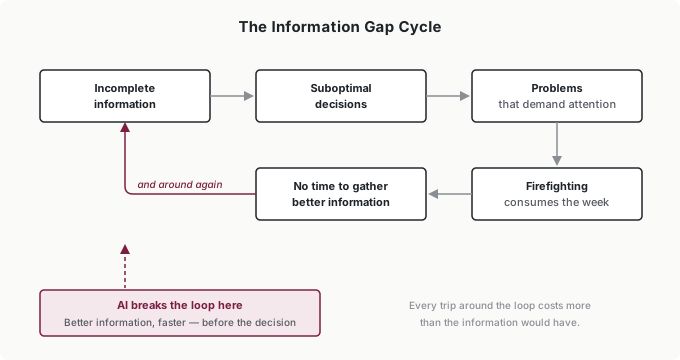
This isn’t a technology problem. It’s been true since the first organization was formed. But the scale has changed dramatically. Consider what a typical knowledge worker deals with today:
- Worldwide email traffic has nearly doubled since 2015, and the average business user now sends and receives over 120 emails per day (Radicati Group)
- Meeting load has surged—Microsoft’s Work Trend Index found the average Teams user spends more than three times as much time in meetings as they did in early 2020
- Messaging platforms like Slack and Teams have become the default communication layer, adding yet another firehose of real-time information to monitor
Your brain hasn’t evolved to match. Neither have your organizational processes.
The traditional solutions—hire more people, work longer hours, use better search tools—don’t scale.
You can’t outrun exponential information growth with linear effort increases.
This is where AI actually creates value—not by replacing human judgment, but by closing the gap between the information you need and the information you have.
Automation vs. Decision Support
The automation mindset asks: “How can AI do this task for me?”
This seems logical. Machines can work faster than humans, 24/7, without getting tired. If AI can do a task, shouldn’t we let it?
Here’s the problem: the automation mindset focuses on replacement. It seeks full autonomy. It measures success by tasks eliminated. And it keeps failing, because it ignores the messy reality of how work actually gets done.
Rachel—the insurance team lead from the opening chapter—had the automation mindset. Her mandate was that AI would handle customer inquiries. She ended up with a chatbot that confidently gave wrong coverage information because no one was asking what decisions the chatbot was making on the company’s behalf.
The decision support mindset asks a different question: “How can AI help me decide better?”
This mindset focuses on augmentation, not replacement. It seeks better information, not full autonomy. It measures success by decision quality, not tasks eliminated. And it works with the intern model—because AI becomes a research assistant, not an autonomous actor.
Note what this is not: it’s not the generic “augmentation, not automation” line from every AI vendor deck. Augmentation talk is still about tasks—doing your tasks faster with AI’s help. Decision support is about something upstream of tasks: what you’d choose to do at all, if you could see clearly.
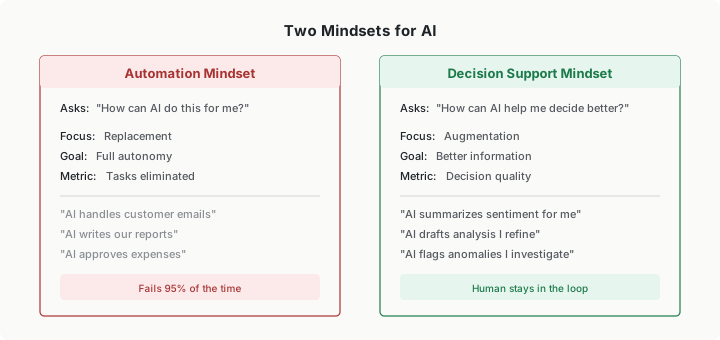
Side by side, the two mindsets ask for different things:
| Automation Mindset | Decision Support Mindset |
|---|---|
| “AI handles customer emails” | “AI summarizes customer sentiment so I can prioritize responses” |
| “AI writes our reports” | “AI drafts analysis so I can focus on recommendations” |
| “AI approves expenses” | “AI flags anomalies so I can investigate exceptions” |
| “AI schedules meetings” | “AI identifies conflicts so I can make tradeoffs” |
In every case, the human stays in the loop. AI provides information; humans make decisions. This is why the decision support approach succeeds where automation fails—it respects the reality that consequential decisions need human judgment, even when AI can help.
The Three Information Problems AI Solves
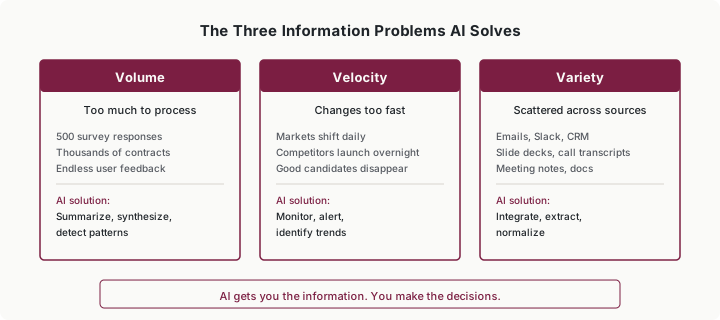
AI is particularly good at solving three specific information problems: volume, velocity, and variety.
If those words sound familiar, they should—data engineers called them the three V’s of big data twenty years ago. But the V’s escaped the data warehouse. They don’t live in your infrastructure anymore; they live in your inbox, your Slack, and your meeting notes. What used to be a database problem is now a personal decision problem, and that’s the version AI can finally do something about.
Problem 1: Volume
You have too much information to process manually.
This was my 12,000-message problem. The customers were telling us exactly why they hesitated—but no human could read four channels of messages and hold the pattern in their head. When I built pattern detection into the message pipeline, the objection the client had asked about turned out to be the third most common one. The two bigger ones weren’t on anybody’s radar, because sampling threads by hand had systematically missed them.
The volume problem shows up everywhere: legal teams with thousands of contracts to review, sales teams with hundreds of prospect interactions to track, product teams with endless user feedback to synthesize, executives with reports they never have time to read fully.
AI solution: summarization, synthesis, and pattern detection. Instead of reading 500 survey responses, you get a summary of the top 5 themes. Instead of scanning every support ticket, you get alerts when a new issue pattern emerges. Instead of skimming reports, you get the key takeaways with the ability to drill down.
This isn’t automation. You’re still making decisions about what to prioritize, how to respond, what to fix. AI just made those decisions better-informed.
Problem 2: Velocity
Information moves faster than you can keep up.
Markets shift. Competitors launch products. Customer preferences evolve. By the time you’ve gathered enough information to make a confident decision, the situation has changed.
The velocity problem is particularly acute in competitive markets where first-mover advantage matters, in customer service where response time affects satisfaction, in risk management where early warning prevents larger problems, and in hiring where good candidates disappear within days.
The old approach—quarterly reports, monthly reviews, weekly syncs—can’t keep pace with daily changes.
AI solution: monitoring, alerting, and trend identification. AI can track changes across more sources than any human team, surfacing what’s relevant without requiring you to constantly scan. You set the parameters for what matters; AI watches for it continuously.
Still not automation. You decide what matters and how to respond. AI just shortened the time between “something changed” and “you know about it.”
Problem 3: Variety
Information is scattered across formats and sources.
Some critical information lives in spreadsheets. Some in email threads. Some in meeting notes, slide decks, CRM systems, Slack channels, recorded calls, shared documents. To make a good decision, you need to synthesize across all of it—but just finding where everything lives is exhausting.
This is the “I know we talked about this somewhere” problem. The information exists. Someone captured it. But it’s in a format or location that makes it effectively invisible when you need it.
Traditional approaches fail here because they require standardized formats. “Just put everything in the CRM” or “just document everything in Confluence” sounds good but never happens completely. Reality is messy.
AI solution: integration, extraction, and normalization. AI can pull relevant information from multiple sources and present it in a consistent format, reducing the hunt. A question like “what did the customer say about pricing concerns?” can search across emails, call transcripts, support tickets, and meeting notes simultaneously.
And still not automation—AI didn’t decide anything. It just ended the hunt.
How This Applies to Your Role
The information problem manifests differently depending on your altitude.
For Department Heads
Your daily decisions: Where should my team focus? Which escalations are real problems versus noise? How should I allocate limited resources?
The gap: you get dozens of inputs—emails, reports, complaints, requests—but you can’t process all of them deeply. You end up prioritizing based on whoever is loudest or most recent, not necessarily what’s most important. What would you prioritize differently if you could actually see all the signals?
AI decision support opportunities:
- Pattern detection across support tickets or customer feedback
- Sentiment tracking to identify emerging issues before they escalate
- Exception flagging so you can focus on anomalies, not routine cases
- Summarization of lengthy reports or email threads
A customer success director I worked with was spending 90 minutes daily reading through support tickets to identify escalation patterns. She implemented an AI summary that categorized tickets by severity, product area, and sentiment—delivered to her inbox each morning. The first two weeks, she kept reading the raw tickets too, and caught the summary underweighting a billing complaint cluster; a category fix solved it. After that, the 15-minute briefing was reliable—and the escalation she caught earliest that quarter was one the old sampling approach would have surfaced a week later, after two more customers had churned.
For Individual Contributors
Your daily decisions: How should I spend my time? What should I work on first? When is something important enough to escalate?
The gap: you’re often missing context. You don’t know what happened in the meeting you weren’t invited to, what the customer said in a different channel, or what priorities shifted since your last sync. What context do you wish you had before making your next decision?
AI decision support opportunities:
- Research synthesis when you need to get up to speed quickly
- Meeting and conversation summaries to fill context gaps
- Status aggregation across multiple systems or channels
- Competitive or market intelligence gathering
A product manager I know starts every sprint planning meeting with an AI-generated summary of what customers said about related features in the past month—pulled from support tickets, sales calls, and NPS comments. Before, she’d go into planning with incomplete context, then discover misaligned priorities mid-sprint. Now she has the full picture before she commits the sprint.
For Small Company CEOs
Your daily decisions: Where should I focus limited resources? Which opportunities are real versus distractions? When do I need to intervene personally?
The gap: you’re the decision bottleneck with the least time to research. Your direct reports each present partial pictures. You make consequential decisions with whatever information is at hand. What information would you gather if you had unlimited time—and how can you get 80% of that value in minutes?
AI decision support opportunities:
- Daily briefings that synthesize overnight developments across the business
- Competitive intelligence monitoring without manual research
- Meeting preparation that pulls relevant context from multiple sources
- Decision frameworks that surface relevant precedents and data
Remember Nadia and her morning briefing from the last chapter? Through the intern-model lens, that story was about clear tasks and trust levels. Through this chapter’s lens, look at what the briefing actually changed: the inventory buildup it surfaced wasn’t a time-saving—it was a decision she would otherwise have made too late. Casual dashboard scanning would have caught the problem weeks later, after the reorder decision was already wrong. The 10-minute briefing didn’t just give her mornings back. It moved a consequential decision from “too late” to “in time.”
For Senior Leaders
Your daily decisions: How should we position strategically? Which signals indicate emerging opportunities or threats? What message needs to reach the organization?
The gap: you have access to more information than anyone else—but it’s fragmented across reports, meetings, and conversations. The most important signals are buried in operational noise. What patterns would you see if you could observe your entire organization simultaneously?
AI decision support opportunities:
- Cross-functional synthesis of what’s happening across the organization
- Strategic intelligence that connects external trends to internal capabilities
- Communication amplification that ensures consistent messaging at scale
- Board and executive preparation that surfaces what matters from voluminous data
Miguel is the senior-leader version of the same shift. His report-synthesis workflow saved him half a day a week—but the strategic payoff was the $140,000 equipment-sharing decision that had been sitting, invisible, across three facility reports nobody had time to compare. No single facility manager could have seen it; the signal only existed across the reports. That’s the senior-leader information problem in miniature: the pattern exists at your altitude and nowhere else, and without synthesis, nobody is looking at it.
The Questions That Guide Implementation
Before any AI implementation, answer these four questions:
1. What decision will this help me make better?
If you can’t name a specific decision, you’re not ready. “Being more productive” isn’t a decision. “Deciding which customer issues to escalate” is a decision. Get specific.
2. What information gap is preventing that decision today?
Identify what’s actually missing. Is it volume (too much to read)? Velocity (changes too fast)? Variety (scattered across sources)? The gap determines the solution.
3. How will I verify the information AI provides?
Remember the intern model. What’s your review process? How will you spot-check for accuracy? AI can give you faster information, but unverified information can be worse than no information.
4. What happens if the information is wrong?
What’s the consequence of acting on bad information? This determines your review level on the Review Spectrum—and whether this is even an appropriate use of AI.
If you can answer these four questions clearly, you have a decision support opportunity worth pursuing. If you can’t, you haven’t found the right problem yet—keep looking.
Most failed AI implementations skipped these questions entirely. They started with “AI is exciting” and ended with “the pilot didn’t produce ROI.”
Common Objections
“Some decisions need to be fast, not well-informed.”
Speed and information aren’t opposites. AI can deliver information in seconds that would take hours to gather manually. The question isn’t “do I have time for good information?”—it’s “how can I get good information faster?”
“My gut is usually right. I don’t need data.”
Your gut is pattern recognition from past experience—which is valuable. But past patterns may not apply to new situations. My client’s team had a gut answer to the conversion question too, and it was wrong: the objection they heard most in sales calls was the third most common one in the message data, because the customers with the two bigger objections never made it to a call. AI doesn’t replace your gut. It tells you when the situation your gut recognizes isn’t the situation you’re actually in.
“My role is about relationships, not information.”
Good relationships depend on being well-informed. Knowing your customer’s history, preferences, and recent interactions makes every conversation more valuable. Information isn’t opposed to relationships—it enables them.
“We don’t have the data for this.”
You might have more than you think. Before assuming you lack data, ask: “If I had an intern who could read every email, every support ticket, every survey response—what would I ask them to find?” That question often reveals data you’re already collecting but not using.
“Isn’t this just business intelligence by another name?”
There’s overlap, but a key difference. Traditional BI works with structured data in defined formats—the numbers that made it into your dashboards. AI-powered decision support can handle unstructured information: emails, meeting notes, customer conversations, call transcripts. In most organizations, that’s where the majority of decision-relevant information actually lives, and it has never been queryable before. It’s not replacing BI; it’s extending decision support to the information BI could never reach.
Your Monday Morning Action Item
This week, identify your information gaps.
List your three most important recurring decisions—choices you make weekly or daily that significantly impact your work or your team.
Now run each one through the four questions from this chapter. What decision is it, specifically? Which of the three V’s is blocking it—volume, velocity, or variety? How would you verify what AI surfaces? And what happens if the information is wrong?
That’s your decision support opportunity map. The biggest gaps—where important decisions suffer from slow or missing information—are where AI can actually help.
Don’t try to solve all three at once. Pick the one where the gap is clearest and the stakes are highest. That’s your starting point.
When I finally ran this exercise on my own client work, the biggest gap wasn’t the one I’d have guessed either. It was the one hiding in 12,000 messages nobody could read.